
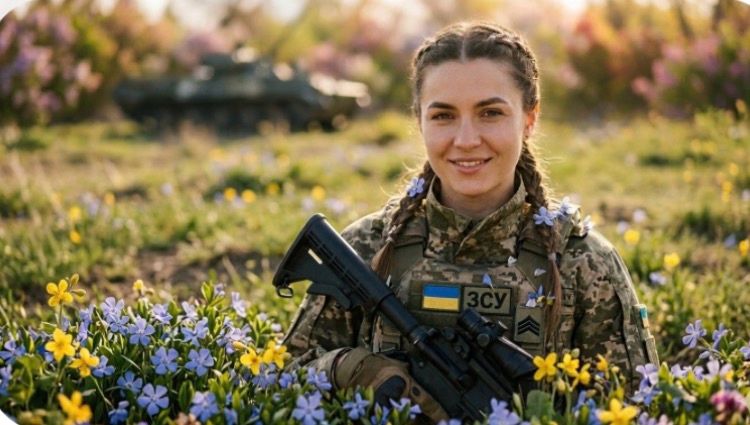
On International Women’s Day, it is worth setting aside the ceremonial and looking at
the data. The numbers describing women’s participation in the world’s armed forces
in 2025 tell a story that no speech can fully capture – one of structural change,
societal transformation, and, in the case of Ukraine, history being made in real time.
A global picture
More than one million women currently serve in armed forces worldwide, across over
190 countries. Twelve countries maintain mandatory military service for women; four
Norway, Sweden, the Netherlands, and Denmark – have introduced fully equal
conscription, placing women and men under identical obligations and opportunities.
These are not symbolic gestures. They reflect a fundamental rethinking of who bears
responsibility for national security.
Regional variation
The regional picture reveals significant divergence. In North America, women
represent approximately 16% of armed forces on average – 17% in the United States
and 15% in Canada – with all combat roles open to women since 2016. Across EMEA
the average sits at around 14%, though the variation is striking: Israel leads at 38%,
Norway at 20%, France at 15%, and the United Kingdom at 11.7%. In the Asia-
Pacific region the average drops to 8%, ranging from New Zealand at 18% to India at
just 0.5%.
The United Kingdom: a moment for reflection
The United Kingdom currently has 16,220 women serving in its Regular Forces,
representing 11.7% of total personnel. The RAF Reserve records the highest
concentration at 23.8%. Yet recent years have seen a decline in female recruitment – a
trend that deserves serious policy attention at a moment when defence capacity is
under renewed scrutiny across Europe.
Ukraine: transformation forged in war
No country better illustrates the relationship between conflict and the role of women
in defence than Ukraine. In 2014, approximately 16,500 women served in the Armed
Forces. By February 2022 that figure had reached 42,000. By January 2025 it stood at
over 70,000 – representing approximately 23% of total military personnel, with 5,500
women serving directly on the front line as snipers, drone operators, and unit
commanders.
The social dimension of this shift is equally significant. Public support for women
serving in the Ukrainian military rose from 53% in 2018 to 80% in 2023. Eight in ten
Ukrainians now believe a woman can command a combat unit as effectively as a
man. This is not merely a statistical change – it is a measurable shift in national
consciousness, accelerated by the most acute security crisis in Europe since 1945.
A note from the author
On this day, the data matters. But behind every figure is a person who made a choice
often under circumstances none of us would wish on anyone. This commentary is
written with those women in mind: those whose names we are still learning, those
who are no longer with us, and those who are holding their position right now.
Dr Halyna Hrynyshyn
CEO, Society, War & Recovery Research Centre