
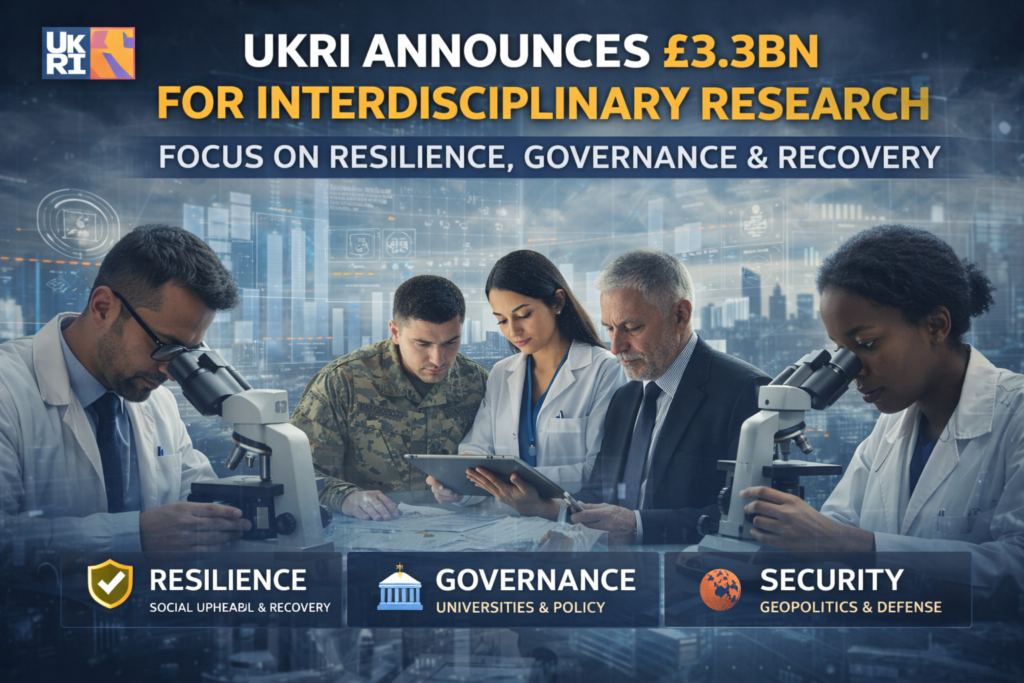
UK Research and Innovation (UKRI) published detailed budget allocation plans on October 30, 2025, for the 2026-2030 spending review period, including £3.3 billion for applicant-led research with particular emphasis on interdisciplinary projects. This announcement comes amid growing recognition of universities’ role in addressing complex societal challenges through the synthesis of social sciences, economics, public policy, and technology.
The Department for Science, Innovation and Technology (DSIT) allocated £38.6 billion to UKRI for the period to 2030, emphasizing strategic priorities including supporting innovative companies, developing critical sectors, and fundamental research. Research England continues to ensure links between research excellence and public impact through £8.9 billion in quality-related (QR) research funding for English universities.
Concurrently, the London School of Economics published on October 24 the report “From Nuclear Deterrence to Democratic Resilience,” exploring new 21st-century security paradigms. Meanwhile, discussions continue about university governance, financial sustainability, and research security against the backdrop of 15,000 job cuts across UK universities over the past year.
Key Facts:
- Funding: £3.3bn for interdisciplinary research focused on societal challenges
- UKRI Strategic Theme: “Building a Secure and Resilient World” includes social upheaval, geopolitics, post-conflict reconstruction
- Governance: Committee of University Chairs (CUC) announced review of Higher Education Code of Governance on October 10, 2025
- Research Security: Government expected to publish research security strategy in coming months
- Challenges: 15,000 university job cuts in past year create tension between security and innovation
- Interdisciplinarity: UKRI concluding cross-council responsive mode pilot, integrating learning across grant programmes
Expert Insight (SWRR Centre):
UKRI’s announcement of £3.3 billion for interdisciplinary research signals a fundamental shift in the UK research ecosystem – from disciplinary ‘silos’ to integrated approaches to complex global challenges. This is particularly relevant for research centers like SWRR that by definition work at the intersection of social sciences, economics, technology, and public policy.
The ‘Building a Secure and Resilient World’ strategic theme directly aligns with our work on post-conflict recovery and societal resilience. The inclusion of social upheaval, geopolitics, and reconstruction in national research priorities creates unique opportunities for centers researching the nexus between war, recovery, and societal transformation.
However, the challenge lies in balancing interdisciplinary ambitions with financial realities. The loss of 15,000 university jobs and increasing research security requirements create tension between openness and protection, between innovation and control. For research centers, this means demonstrating not only academic excellence but clear societal impact and financial sustainability.
The shift from UKRI’s ‘tactical’ to ‘strategic’ approach, as articulated by new CEO Ian Chapman on October 6, may mean universities must more clearly articulate their research specializations. For new centers like SWRR, this is a moment to position ourselves as experts in critical interdisciplinary niches that align with national priorities.
Sources:
UK Research and Innovation – Budget allocations announcement, 30 October 2025
UKRI Framework Document 2025, published 24 November 2025
London School of Economics – “From Nuclear Deterrence to Democratic Resilience” policy paper, 24 October 2025
Committee of University Chairs – Call for Evidence for CUC Code review, 10 October 2025
University and College Union – Job losses data, October 2025
Research Professional News – Multiple reports on UK university sector, October 2025