Insights & Updates

Europe Steps Up as US Steps Back

Europe Steps Up as US Steps Back: The Shifting Architecture of InternationalSupport for Ukraine

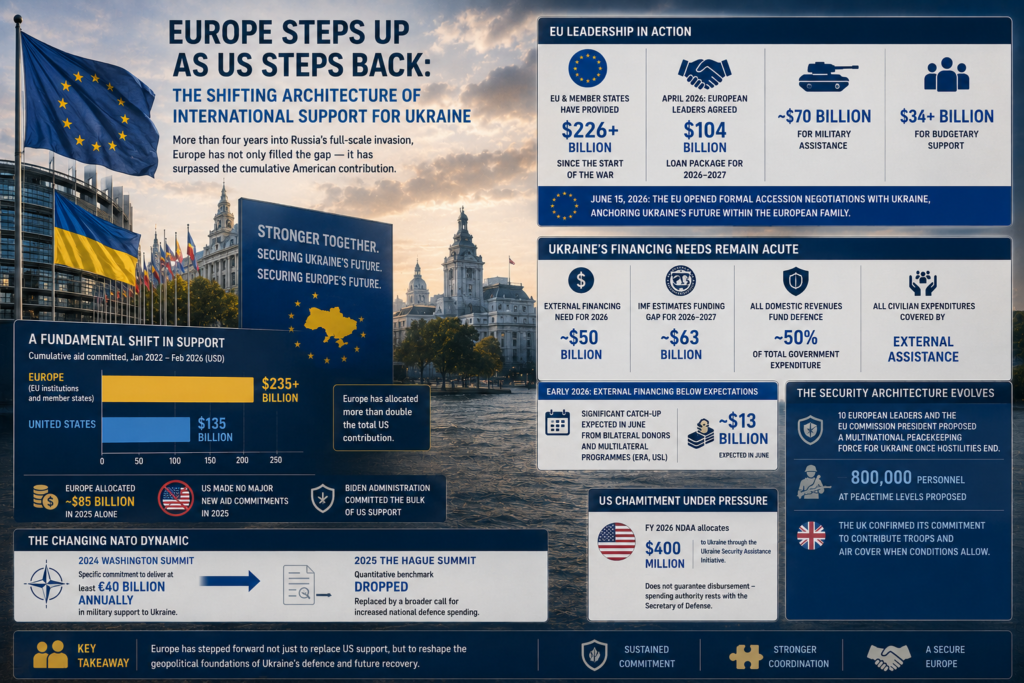
More than four years into Russia’s full-scale invasion of Ukraine, the architecture of international support has undergone a structural transformation. The United States, which led Western assistance in the early years of the war, has effectively paused new financial and military commitments since early 2025. Europe has not only filled the gap — it has surpassed the cumulative American contribution, reshaping the geopolitical foundations on which Ukraine’s defence and eventual recovery depend.The scale of the shift is significant. Between January 2022 and February 2026, European countries collectively allocated more than 235 billion dollars in military, financial, and humanitarian aid to Ukraine — more than double the total US contribution of approximately 135 billion dollars over the same period. The United States committed the bulk of its support under the Biden administration, with no major new funding approved since 2024. In contrast, European countries allocated around 85 billion dollars in 2025 alone, accelerating their contributions precisely as Washington drew back.The European Union has emerged as the single largest institutional backer. Since the start of the war, the EU and its member states have made available over 226 billion dollars in combined assistance. In April 2026, European leaders agreed a further loan package of 104 billion dollars to cover Ukraine’s needs through 2026 and 2027 — of which nearly 70 billion is earmarked for military assistance and over 34 billion for budgetary support. In a significant parallel development, the EU opened formal accession negotiations with Ukraine on 15 June 2026, anchoring the country’s long-term future within the European institutional order.Ukraine’s financing needs remain acute. The IMF estimates a funding gap of approximately 63 billion dollars for 2026–2027, with total external financing requirements for 2026 placed at around 50 billion dollars. All domestic budget revenues are directed to defence, which accounts for roughly half of total government expenditure; civilian spending is covered entirely by external assistance.Early 2026 saw external financing arrive below expected levels, though a significant catch-up was anticipated in June from bilateral donors and multilateral programmes including the ERA and USL facilities.The shift in burden has exposed structural tensions within the Western coalition. The 2024 NATO summit in Washington included a specific collective commitment to deliver at least 40 billion euros annually in military support to Ukraine. By the 2025 Hague summit, that benchmark had been dropped, replaced by a broader call for increased national defence spending. The US NDAA for fiscal year 2026 allocated 400 million dollars to Ukraine through the Ukraine Security Assistance Initiative — a modest figure compared to earlier years, and one that does not guarantee disbursement, as spending authority ultimately rests with the Secretary of Defense.Europe’s response has included not only financial commitments but steps toward a new security architecture. Ten European leaders, alongside the European Commission President, proposed a multinational peacekeeping force for Ukraine to be deployed once hostilities end, backed by a sustained force of 800,000 personnel at peacetime levels. The UK confirmed its commitment to contributing troops and air cover to such a mission when conditions allow. Key Facts: Expert Insight (SWRR Centre)The reconfiguration of international support for Ukraine is analytically significant beyond the immediate military and fiscal dimensions. It represents a live stress test of what Western institutional solidarity looks like when the principal guarantor of that solidarity changes its strategic priorities.Several questions arise from this shift that are directly relevant to understanding governance and institutional resilience under crisis conditions. The first concerns sustainability. European support has grown impressively in aggregate, but it remains fragmented across bilateral commitments, EUinstruments, and NATO frameworks — each with different decision-making cycles, disbursement mechanisms, and political accountability structures. The Kiel Institute and CSIS assessments both note that the challenge for Europe is less aggregate spending capacity than the structural ability to deliver specific capabilities — particularly air defence systems and large-calibre artillery — at the scale and consistency Ukraine requires.The second concerns the political durability of support over time. The withdrawal of a clear quantitative benchmark at the 2025 NATO summit is a meaningful signal: it reflects the difficulty of maintaining binding collective commitments across democratically elected governments facingdomestic fiscal pressures. For researchers studying how institutions perform under sustained crisis conditions, the Ukraine support architecture offers an unusually well-documented case of coalition management at scale — its partial successes, coordination failures, and adaptation under pressure all visible in real time.The opening of EU accession negotiations in June 2026 adds a further dimension: it transforms the relationship between Ukraine and its primary backers from emergency support to institutional integration, with different incentive structures and accountability mechanisms. Whether thattransition strengthens or complicates the continuity of support during active conflict is a question without clear precedent. SourcesEuropean External Action Service, EU Assistance to Ukraine, updated June 16, 2026:https://www.eeas.europa.eu/delegations/united-states-america/eu-assistance-ukraine-us-dollars_en Council on Foreign Relations, How Much Aid Has the US Sent Ukraine, updated June 26, 2026:https://www.cfr.org/articles/how-much-us-aid-going-ukraine CEPA, Wartime Assistance to Ukraine: Successes, Failures and Future Prospects, January 2026:https://cepa.org/comprehensive-reports/wartime-assistance-to-ukraine-the-successes-failures-and-future-prospects-of-us-and-eu-support-models/ OSW Centre for Eastern Studies, US Defence Budget for 2026, December 2025:https://www.osw.waw.pl/en/publikacje/analyses/2025-12-19/us-defence-budget-2026-congress-approves-continued-support-ukraineCSIS, How Europe Can Build Ukraine’s Future Force, May 2026:https://www.csis.org/analysis/how-europe-can-build-ukraines-future-force
Europe Steps Up as US Steps Back: The Shifting Architecture of InternationalSupport for Ukraine Read More »

trump tariff regime uk 1536x1024

Trump’s Tariff Regime and the New Era of Economic Coercion: What It Means forthe UK

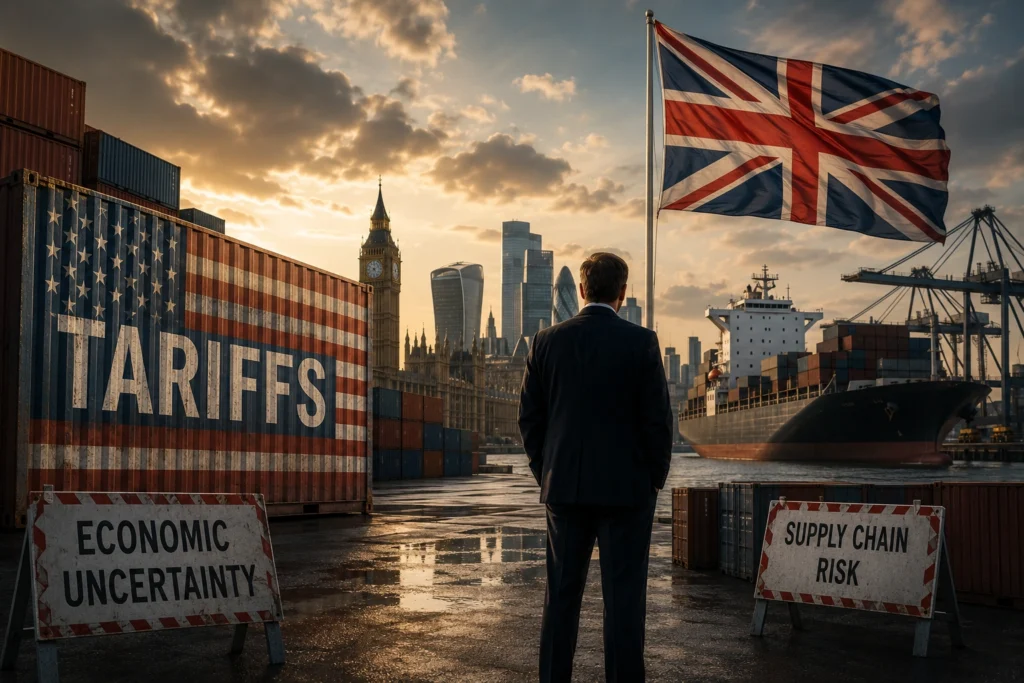
Since returning to office in January 2025, President Donald Trump has pursued the most sweepingoverhaul of US trade policy in a generation. A cascade of tariffs — on steel, aluminium,automobiles, semiconductors, and a broad range of consumer goods — has fundamentally alteredthe terms on which the United States engages with the global economy. For the United Kingdom, anopen economy historically dependent on predictable, rules-based international trade, theimplications are structural rather than merely transactional.The scale of the tariff programme is without modern precedent. According to the Tax Foundation,Trump’s tariffs constitute the largest US tax increase as a share of GDP since 1993, amounting to anaverage additional burden of approximately 1,500 dollars per US household in 2026. The measuresinclude a 25% tariff on all steel and aluminium imports — raised to 50% in June 2025 — a 25%tariff on passenger vehicles and automobile parts introduced in spring 2025, and a baseline 10%tariff on most other imports following the US Supreme Court’s February 2026 ruling that thebroader reciprocal tariff framework exceeded presidential authority under emergency powerslegislation. That ruling changed the legal basis for the tariffs but did not remove them: theadministration promptly reimposed a 10% global tariff under alternative statutory authority, validfor 150 days pending potential congressional extension.The direct exposure for the UK is concentrated in several sectors. Steel and aluminium exports tothe US face a combined tariff of 35% — the 10% baseline stacked on top of the 25% sector-specificrate — with the UK having missed the July 2025 deadline to negotiate a tailored exemption underthe UK-US Economic Prosperity Deal. Roughly half of the 37,000 jobs in the UK steel industry arelocated in Wales and Yorkshire and the Humber, making the tariff’s geographic impact highlyconcentrated. On pharmaceuticals — the UK’s second-largest goods export to the United States — aseparate deal reached in October 2025 averted immediate tariffs, though it required the UK to raiseNHS drug prices and increase NHS spending, concessions that carry their own domesticimplications. Automobiles remain subject to 25% tariffs, with negotiations ongoing.The broader economic impact on the UK has been measured but real. The Office for BudgetResponsibility forecast in November 2025 that UK export markets would grow more slowly overthe following four years and that global trade intensity would fall. The OECD revised its UKgrowth forecast downward partly on the basis of the trade policy environment. Research on tariffpass-through from the first Trump administration indicates that the cost of tariffs is borneoverwhelmingly by importing businesses and consumers in the receiving country — not, as theWhite House has argued, by the exporting nation. A 20% tariff translates into roughly an 18.5%increase in import prices, most of which is either absorbed by firms as reduced margins or passedon to consumers as higher prices.The wider significance extends beyond bilateral trade economics. The Trump administration’swillingness to deploy tariffs as a geopolitical instrument — including a January 2026 announcementof 10% tariffs on European countries opposing US plans over Greenland, with a threat to raise themto 25% — signals a qualitative shift in how economic leverage is being used by major powers.Chatham House has described this as the emergence of an era of economic coercion, in which tradepolicy is increasingly detached from rules-based norms and deployed in service of geopoliticalobjectives that may have little connection to trade imbalances. For the UK, outside the EU andtherefore without the collective bargaining weight of a major trade bloc, managing this environmentbilaterally presents structural vulnerabilities that no single deal can fully resolve.Key Facts:Trump’s tariffs represent the largest US tax increase as a share of GDP since 1993; estimatedat an average of 1,500 dollars per US household in 2026 UK steel and aluminium exports face a combined 35% tariff rate; steel industry employsapproximately 37,000 people in the UK, concentrated in Wales and YorkshireA 10% baseline tariff on most UK goods remains in place following the February 2026Supreme Court ruling, reimposed under alternative statutory authorityThe OBR forecast in November 2025 that UK export market growth would slow over thenext four years as a result of the global trade environmentA UK-US pharmaceuticals deal in October 2025 averted immediate tariffs but required theUK to raise NHS drug pricesResearch shows that approximately 80–85% of US tariff costs are absorbed domestically byUS businesses or passed on to US consumers — not paid by the exporting countryThe Tax Foundation estimates that retaliatory tariffs already affect more than 223 billiondollars of US exports globallyExpert Insight (SWRR Centre)The Trump tariff regime matters for SWRR Centre’s research agenda not primarily as a trade policystory but as an example of how economic systems come under stress when the institutional rulesgoverning them are contested or abandoned by a dominant actor.The rules-based international trading order — built through decades of multilateral negotiation —functions as a form of systemic resilience infrastructure. It reduces uncertainty, enables long-terminvestment planning, and distributes the costs of economic adjustment through agreed mechanismsrather than unilateral power. When a state of the United States’ scale exits that frameworkselectively and unpredictably, the resulting uncertainty is itself a form of structural damage —visible in the OBR’s downgraded forecasts, in corporate supply chain restructuring, and in thediplomatic energy being consumed by economies like the UK’s in managing bilateral exposurerather than pursuing growth.For the UK specifically, the tariff environment illuminates a vulnerability that predates Trump: theabsence of collective bargaining weight following EU exit. The EU has responded to US tariffs withcoordinated countermeasures and negotiating leverage derived from market scale. The UK hasnavigated the same environment through bilateral deal-making, accepting concessions — on NHSdrug pricing, on steel quotas — that reflect an asymmetric negotiating position. This is not anargument about the merits of any particular trade arrangement; it is an observation about howstructural position shapes resilience when external economic shocks arrive. The current episodeoffers a well-documented case study in economic exposure and adaptive capacity that will remainanalytically relevant long after the specific tariff rates have changed.SourcesHouse of Commons Library, US Trade Tariffs, updated June 2026:https://commonslibrary.parliament.uk/research-briefings/cbp-10240/ Economics Observatory, The UK-US Trade Deal: What Will Be the Effects?https://www.economicsobservatory.com/the-uk-us-trade-deal-what-will-be-the-effects Chatham House, Trump’s Greenland Tariffs Show the UK

Trump’s Tariff Regime and the New Era of Economic Coercion: What It Means forthe UK Read More »

Ukraine's National Bank Cuts Rate

Ukraine’s National Bank Cuts Rate to 15% in January 2026 — Then Holdsas Middle East Shock Upends Easing Cycle

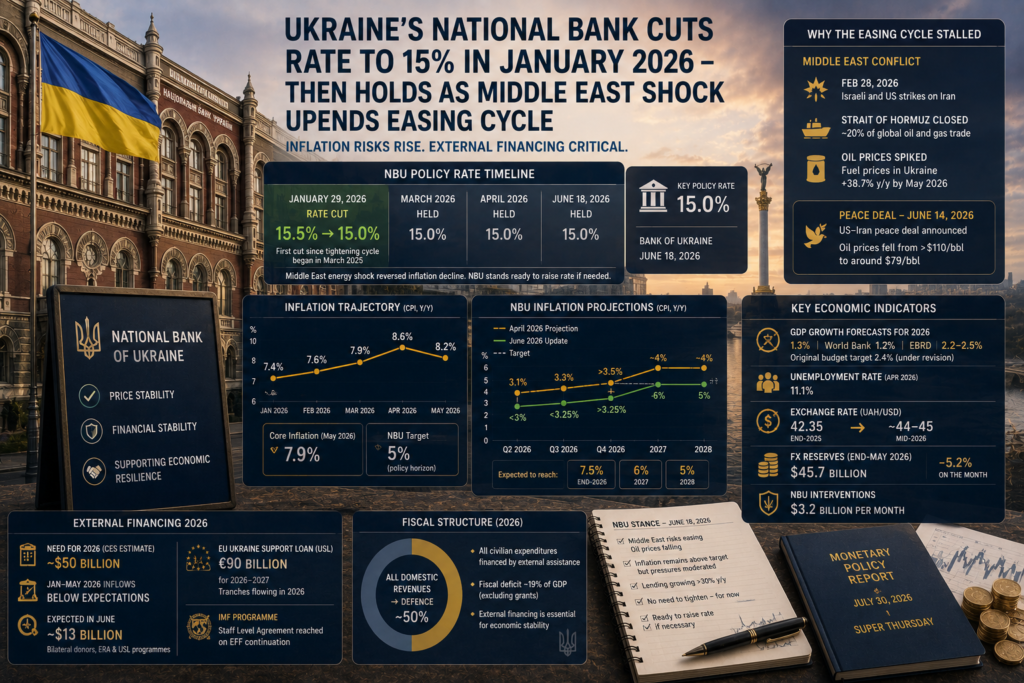
On January 29, 2026, the National Bank of Ukraine (NBU) cut its key policy rate by 50 basis points — from 15.5% to 15% — marking the start of what was expected to be a gradual monetary easing cycle. The decision reflected a sustained decline in inflationary pressures through late 2025: consumer and core inflation had slowed to 8% year-on-year in December, driven by a strong harvest season, easing labour market pressures, and a stable foreign exchange market. Crucially, the EU Council’s late-2025 decision to provide Ukraine with €90 billion in financial assistance over 2026–2027 — the Ukraine Support Loan — had materially reduced the external financing risks that had kept the NBU on hold for seven consecutive meetings since March 2025. With reserves at $57.3 billion at end-2025, the NBU judged conditions sufficient to begin easing.That easing cycle stalled almost immediately. The outbreak of the Middle East conflict in late February 2026, and the subsequent closure of the Strait of Hormuz, pushed global oil and fuel prices sharply higher. Ukraine, heavily dependent on imported fuel, saw fuel prices rise 38.7% year-on-year by May 2026. CPI inflation, which had been expected to decline steadily toward the NBU’s 5% target, instead reversed course: from 7.4% in January, inflation rose to 7.9% in March, 8.6% in April, and 8.2% in May. Core inflation accelerated to 7.9% in May — both figures above the NBU’s April forecast trajectory, primarily due to second-round effects of energy price growth. The NBU held rates at 15% at its March, April, and June meetings, each time citing rising inflationary risks and signalling readiness to raise rates if underlying price pressures intensified.The external financing picture — always the most consequential variable in Ukraine’s wartime macroeconomic framework — also became more strained in early 2026. The Centre for Economic Strategy estimates Ukraine’s external financing need for 2026 at approximately $50 billion. All domestic budget revenues go to financing defence, which accounts for roughly half of total expenditures; all civilian expenditures are covered by external assistance. The fiscal deficit runs at approximately 19% of GDP excluding grants, and is structurally dependent on the continuity of international support. External financing in January–May 2026 came in below expectations, though the NBU expects a significant catch-up in June: Ukraine is expected to receive approximately $13 billion in June alone, from bilateral donors and under the ERA (Extraordinary Revenue Acceleration) and USL programmes. Progress in IMF negotiations — a Staff Level Agreement was reached — is an important signal for future EFF (Extended Fund Facility) tranches. International reserves declined to $45.7 billion at end-May 2026, with the NBU intervening at $3.2 billion per month to support the hryvnia. The official exchange rate depreciated gradually from UAH 42.35 per dollar at end-2025 to approximately UAH 44–45 per dollar by mid-2026, under the NBU’s managed flexibility regime.At its June 18 meeting, the NBU held the rate at 15% but shifted its tone slightly: with oil prices falling following the US–Iran peace deal announced on June 14, the NBU noted that easing Middle East risks and lower global energy prices should reduce Ukraine’s energy import costs and help contain inflation. It noted growing lending volumes — credit is expanding at over 30% annually — as evidence that monetary conditions are not impeding economic activity, and confirmed that it currently sees no need to tighten policy while also standing ready to raise rates if necessary. Key Facts: Expert Insight (SWRR Centre):Ukraine’s monetary policy in 2026 illustrates a pattern that is structurally distinct from conventional central banking: the NBU is simultaneously managing inflation, exchange rate stability, and the confidence of external financing partners — each with different and sometimes conflicting requirements. The January cut was possible precisely because the EU loan commitment had reduced external financing uncertainty, allowing the NBU to prioritise the growth-supporting dimension of its mandate. The subsequent hold was imposed not by domestic data deteriorating but by an external shock — the Middle East conflict — feeding into fuel prices and inflation expectations before the domestic easing had meaningfully begun. The result is a central bank that cut once, then spent five months explaining why it cannot cut again.The structural dependence on external financing deserves particular attention as a governance and resilience question. Ukraine’s fiscal framework is essentially bifurcated: the state raises domestic revenues for defence, and international partners fund everything else. This arrangement has held through four years of full-scale war, but it creates a specific vulnerability — the continuity of civilian public services, infrastructure maintenance, and social protection is directly contingent on the political decisions of donor governments and the disbursement calendars of multilateral institutions. The January–May financing shortfall, and the expectation of a $13 billion catch-up in June, illustrates how this contingency plays out in practice: budget execution becomes a function of external disbursement timing, not domestic revenue planning.The NBU’s management of the exchange rate under managed flexibility — maintaining a gradual, controlled depreciation rather than a fixed peg or free float — is one of the more consequential institutional choices in Ukraine’s wartime economic management. It preserves competitiveness signals, avoids the credibility cost of a sudden devaluation, and maintains the NBU’s ability to intervene when needed. At $45.7 billion, reserves remain above the threshold typically considered adequate for this regime, but the monthly intervention pace of $3.2 billion is not sustainableindefinitely if external financing inflows remain irregular. The June peace deal in the Middle East, y easing fuel price pressures, has provided some relief to this equation — but the NBU’s own caution about readiness to raise rates signals that the relief is not yet treated as durable. Sources:National Bank of Ukraine — “NBU Cuts Key Policy Rate to 15%,” January 29, 2026National Bank of Ukraine — “NBU Leaves Its Key Policy Rate Unchanged at 15%,” June 18, 2026Centre for Economic Strategy — “Ukraine War Economy Tracker,” updated June 2026EBRD — “Ukraine maintains macroeconomic stability despite war,” Regional Economic Prospects, February 2026Ukrainian Institute for the Future — “Macroeconomic Digest of Ukraine

Ukraine’s National Bank Cuts Rate to 15% in January 2026 — Then Holdsas Middle East Shock Upends Easing Cycle Read More »

Bank of England Holds Rate

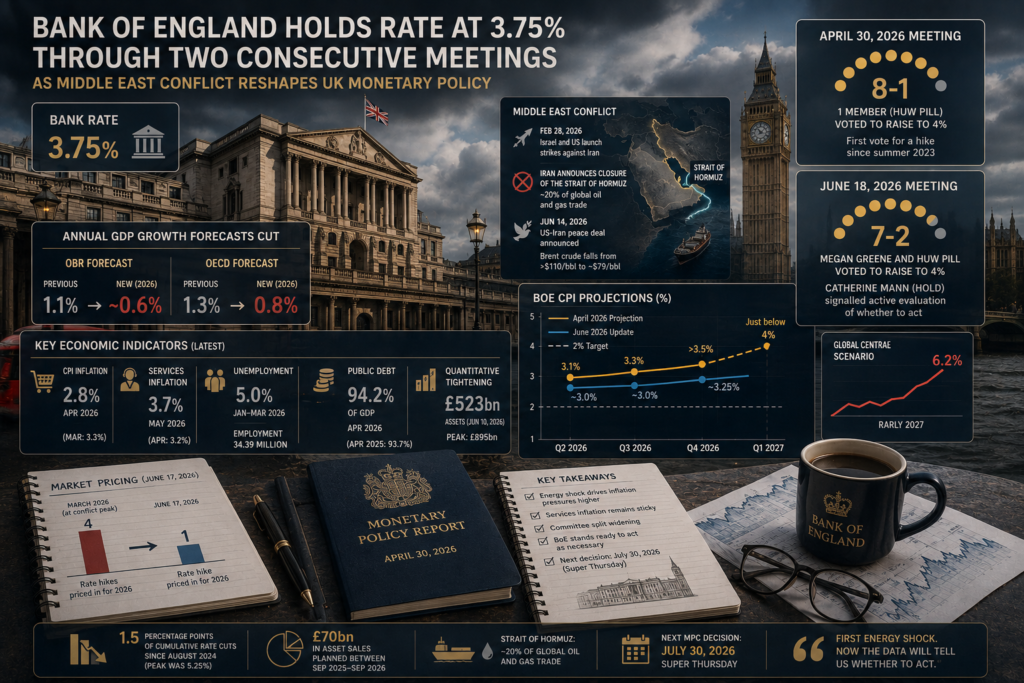
Bank of England Holds Rate at 3.75% Through Two ConsecutiveMeetings as Middle East Conflict Reshapes UK Monetary Policy

The Bank of England’s Monetary Policy Committee held Bank Rate at 3.75% at both its April 30 and June 18 meetings, but the picture behind the headline decision has shifted materially between the two. The April vote was 8-1, with a single hawkish dissent — the first vote for a rate increase since the tightening cycle ended in summer 2023. By June, that dissent had grown to 7-2, with Megan Greene and Huw Pill both voting to raise rates to 4%, while a third member, Catherine Mann, indicated in her published rationale that she is actively evaluating whether to act. The direction of travel within the committee is clear: the question is no longer whether the MPC will maintain its dovish stance indefinitely, but whether the data will force a move before the year is out.The context for both decisions is the energy shock triggered by the Middle East conflict. Following Israeli and US strikes on Iran on February 28, 2026, and the subsequent closure of the Strait of Hormuz, oil and gas prices rose sharply, upending the Bank’s pre-conflict projections. Before the conflict, the Bank expected CPI inflation to fall to around 2% from April 2026 and remain close to target for the rest of the year. In its April Monetary Policy Report, the Bank revised those projections significantly upward: CPI was now projected at 3.1% in Q2, 3.3% in Q3, and rising further in Q4, with the Bank’s adverse scenario placing peak inflation just below 4% in early 2027.A worst-case scenario put the figure at 6.2%.The June meeting was shaped by two new developments. First, on June 14 — four days before the vote — the United States and Iran announced a peace deal, and Brent crude oil fell sharply from above $110 per barrel to around $79. This eased the near-term inflation outlook sufficiently to keepthe majority on hold. Second, May CPI data, released on June 17, held at 2.8% — below expectations — though services inflation ticked back up to 3.7%, maintaining the committee’s concern about domestic price pressure. The June minutes noted that global energy prices “remain higher than pre-conflict and have continued to be volatile,” and that “the impact of the energy shock on the UK economy remains uncertain.” The Bank stated it “stands ready to act as necessary” and confirmed the next Monetary Policy Report — a “Super Thursday” — will be published alongside the July 30 decision.Market pricing has oscillated sharply across the period. At the height of the conflict in March, markets were pricing as many as four rate hikes in 2026. By June 17, that had fallen to roughly one hike priced in for the year. Economist forecasts diverge widely: Bank of America expects hikes inJuly and September; ING pencils in a “one-and-done” rise this summer; Oxford Economics expects no change through 2026 and well into 2027; Pantheon Macroeconomics and Deutsche Bank have both removed their hike forecasts following the ceasefire. On quantitative tightening, the MPC is reducing its asset holdings from a peak of £895 billion to £523 billion, with £70 billion in sales planned between September 2025 and September 2026. Key Facts: Expert Insight (SWRR Centre):The shift from an 8-1 to a 7-2 vote in six weeks, against a backdrop in which the peace deal has reduced near-term energy price pressure, is a striking illustration of how rapidly monetary policy committees can move from apparent consensus to active internal disagreement. The headlinedecision — hold — is the same on both dates. But the MPC communicating through the vote split and published individual rationales is a different instrument from the headline rate, and the June minutes are meaningfully more hawkish than April’s despite energy prices having fallen in the interim. The explanation lies in services inflation: at 3.7% in May and moving in the wrong direction, domestic price pressure is providing a basis for hawkish dissent that is independent of the energy shock itself.The divergence between the BoE and the ECB is worth tracking as a structural observation. The ECB raised rates on June 11 — citing Middle East-generated inflation — while the BoE held a week later, citing the same conflict but emphasising the uncertainty and the loosening labour market. Both are responding to the same external shock; the different decisions reflect different institutional risk assessments, different labour market dynamics, and different fiscal contexts. For anyone studying how institutions respond to shared external pressures, this is a live natural experiment: two central banks, one shock, diverging policy paths.The peace deal’s impact on the June decision also illustrates a recurring challenge for central banks operating in geopolitically volatile environments: the data used to justify a decision can shift materially between the deliberations and the announcement, let alone between the announcement and the next meeting. The MPC’s emphasis on “monitoring closely the situation in the Middle East” and standing “ready to act as necessary” is not boilerplate — it is an acknowledgement that the standard six-week deliberation cycle is poorly matched to the speed at which geopolitical conditions can move. Sources:Bank of England — “Bank Rate maintained at 3.75% — June 2026 Monetary Policy Summary and Minutes,” June 18, 2026Bank of England — “Monetary Policy Report,” April 30, 2026House of Commons Library — “Interest rates and monetary policy: Economic indicators,” updated June 18, 2026HomeOwners Alliance — “Latest UK Interest Rate Forecasts,” updated June 18, 2026BritSavvy — “Bank of England June 2026 — Hold at 3.75%. What It Means,” June 18, 2026 Cambridge Currencies — “UK Interest Rate Forecast 2026: Next Bank of England Decision,” updated June 2026CNBC — “Bank of England April 2026 interest rate decision,” April 30, 2026

Bank of England Holds Rate at 3.75% Through Two ConsecutiveMeetings as Middle East Conflict Reshapes UK Monetary Policy Read More »

Ukraine's GDP Falls

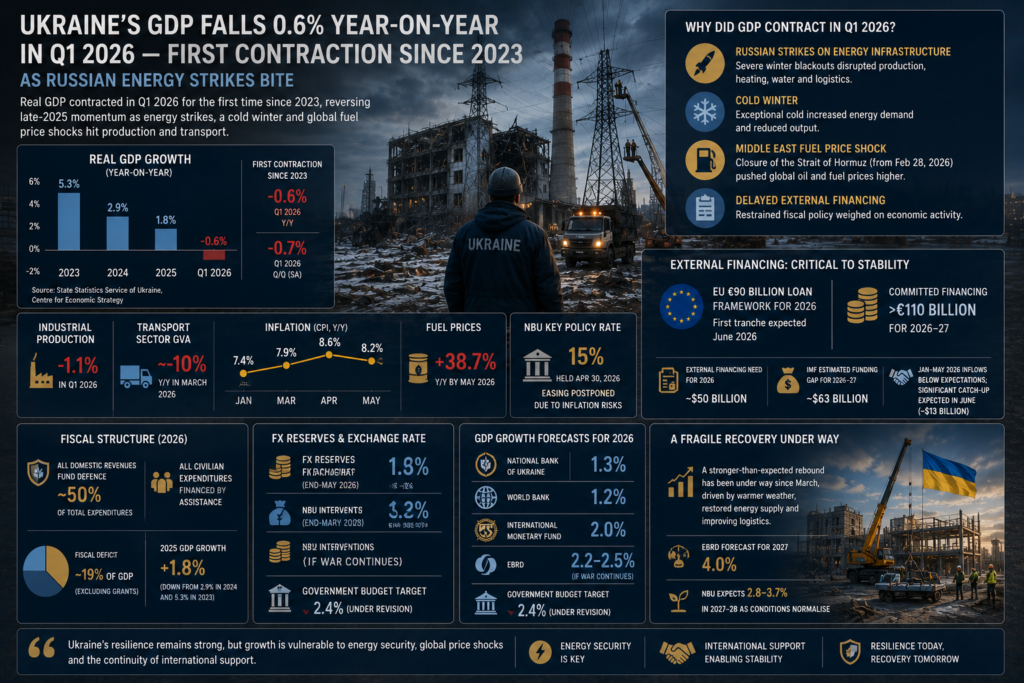
Ukraine’s GDP Falls 0.6% Year-on-Year in Q1 2026 — First ContractionSince 2023 as Russian Energy Strikes Bite

Ukraine’s real GDP contracted in the first quarter of 2026 for the first time since 2023, declining between 0.5% and 0.6% year-on-year and 0.7% quarter-on-quarter on a seasonally adjusted basis, according to Ukraine’s State Statistics Service and the Centre for Economic Strategy. Thecontraction marks a sharp reversal from the momentum of late 2025, when quarterly growth had accelerated to 2.1% in Q3 and 3.0% in Q4 year-on-year. The primary cause was a severe energy crisis triggered by intensified Russian strikes on Ukraine’s energy infrastructure during an exceptionally cold winter. Long blackouts disrupted industrial production, water and heating supplies, and logistics across the country. Industrial output fell 1.1%in Q1, with the sharpest declines in January and February before a partial rebound in March as temperatures rose and some energy supply was restored. The transport sector was among the hardest hit, with gross value added falling approximately 10% year-on-year in March alone, drivenby higher fuel costs and reduced volumes of iron ore and oil shipping. Restrained fiscal policy — linked to delays in external financing — also weighed on activity.A second external shock compounded the domestic energy crisis: the closure of the Strait of Hormuz from February 28, 2026 following the Israel-US strikes on Iran pushed global oil and fuel prices higher, feeding directly into Ukraine’s import-dependent fuel costs and business energy bills.Fuel prices rose 38.7% year-on-year by May 2026, becoming a significant driver of renewed inflation. After easing to 7.4% year-on-year in January 2026, inflation climbed to 7.9% in March, 8.6% in April, and eased only slightly to 8.2% in May.Ukraine’s Economy Minister Oleksii Sobolev confirmed in May that the government is preparing a downward revision of its macroeconomic forecast, reducing the 2.4% growth target set in the state budget. The National Bank of Ukraine also cut its 2026 growth forecast to 1.3% from 1.8%, citingthe weak Q1 result, the fragile state of the energy system, and Middle East war spillovers. However, the government noted that a stronger-than-expected rebound has been under way since March, and expressed hope that spring recovery momentum would partially offset the Q1 losses. Key Facts: Expert Insight (SWRR Centre):Ukraine’s Q1 2026 contraction is a textbook illustration of how compound shocks interact in a war economy. The energy crisis was not new — Russian strikes on energy infrastructure have been a persistent feature of the war — but the combination of an unusually cold winter, intensified bombardment, and an external fuel price shock from the Middle East created a confluence that proved sufficient to reverse the growth trajectory of late 2025. The speed of the reversal — from 3.0% growth in Q4 2025 to a contraction in Q1 2026 — reflects the structural fragility of an economy that, despite considerable resilience, remains dependent on weather, external financing cycles, and global energy prices simultaneously.The divergence between international forecasters is itself instructive. The gap between the World Bank’s 1.2% and the EBRD’s 2.5% for the same year reflects genuine uncertainty about how quickly the energy system can recover and how much of the Q1 contraction is genuinely seasonal versus structural. The Economy Minister’s note of a “strong rebound since March” suggests the lower forecasts may prove too pessimistic — but the same officials are simultaneously revising the budget target downward, which captures the difficulty of forecasting in a live conflict environment.The degree to which external financing is holding the macro framework together is also worth noting. Ukraine’s fiscal deficit is fully financed by external partners; without that, the monetary and exchange rate stability the NBU has maintained would not be possible. This makes Ukraine’seconomic trajectory unusually sensitive to the political decisions of donor governments — a dynamic that extends beyond economics into governance and security policy. Sources:Centre for Economic Strategy — “Ukraine War Economy Tracker,” updated June 11, 2026Reuters / Global Banking & Finance — “Ukraine’s GDP Shrinks 0.5% in Q1 2026,” May 5, 2026Kyiv Post — “Ukraine’s GDP Shrinks 0.5% in Q1 2026 as War Strain Persists,” May 8, 2026New Voice of Ukraine — “Ukraine government cuts GDP growth forecast after energy strikes caused Q1 contraction,” May 18, 2026EBRD — “Ukraine maintains macroeconomic stability despite war,” Regional Economic Prospects, February 26, 2026Interfax Ukraine — “Ukraine’s real GDP contracting for third consecutive month, declines 0.6% in Q1 2026,” April 22, 2026

Ukraine’s GDP Falls 0.6% Year-on-Year in Q1 2026 — First ContractionSince 2023 as Russian Energy Strikes Bite Read More »

Applications in the Year to March

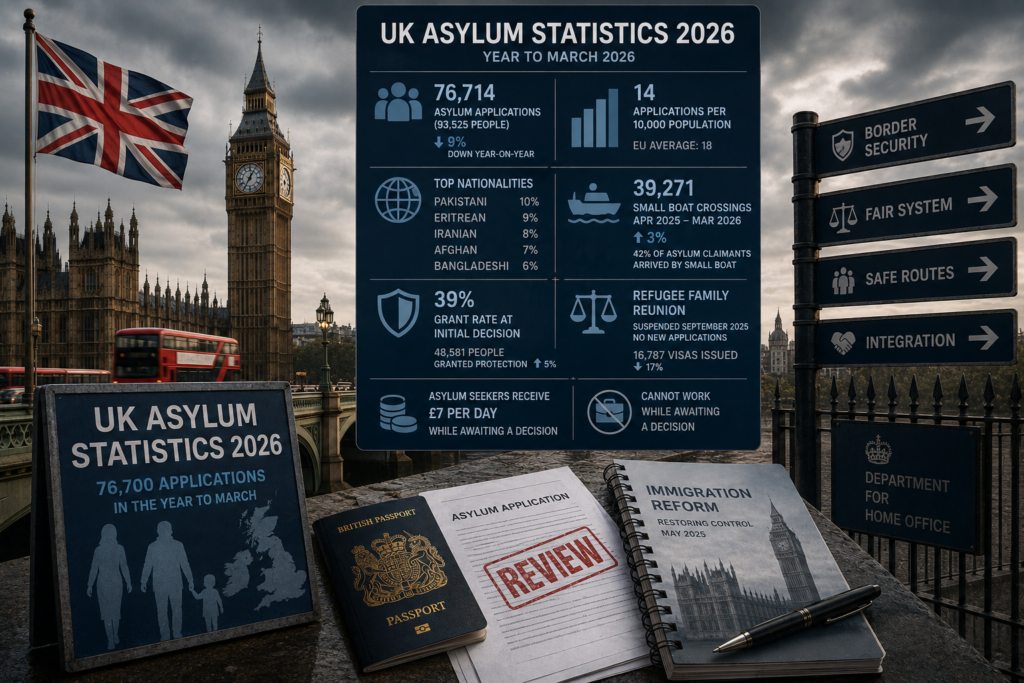
UK Asylum Statistics 2026: 76,700 Applications in the Year to March — Below EUAverage, But System Under Significant Reform Pressure

There were 76,714 asylum applications in the UK in the year to March 2026, relating to 93,525 people — a 9% decrease from the previous twelve months and the second consecutive annual fall after the record of 105,000 applications in 2024. On a per-capita basis, the UK received approximately 14 asylum applications for every 10,000 people — below the EU member state average of 18 per 10,000, placing the UK 12th on a combined list of the 27 EU member states and the UK. The figures do not include Ukrainians, who are covered by separate humanitarian schemes and do not enter the general asylum statistics.The most common nationalities applying for asylum in the year to March 2026 were Pakistani (10%), Eritrean (9%), Iranian (8%), Afghan (7%), and Bangladeshi (6%) — together accounting for 40% of all applicants. Around 42% of those who claimed asylum in that year arrived by small boatacross the Channel, up from roughly a third since 2018. Channel crossings totalled 39,271 between April 2025 and March 2026, a 3% increase on the previous year, though the trend has since reversed: as of late May 2026, crossings were running 40% lower than at the same point in 2025.The UK and France agreed a new three-year funding arrangement in April 2026, worth £662 million, to address unauthorised migration including small boat crossings.At initial decision stage, 39% of decisions in the year to March 2026 resulted in a grant of protection — meaning those people were confirmed as refugees or received humanitarian protection. A total of 48,581 people were granted protection as a result of an asylum claim, a 5% increase from the previous year. The proportion of asylum appeals allowed in 2025 was 39%, broadly unchanged from the prior year, though an increasing number of appeals are being withdrawn before courts make a decision. On positive asylum decisions per capita, the UK granted approximately four per 10,000 people in 2025 — below the EU average of seven, with Greece granting the most (26 per 10,000) and Hungary the fewest.Refugee family reunion — one of the main safe and legal routes to the UK for refugees joining family members — has been suspended since September 2025. The government announced it was closing the route to new applications while reviewing its conditions, citing concerns that it wasencouraging asylum claims and adding pressure on housing and public services. In the year to March 2026, 16,787 family reunion visas were issued — a 17% fall reflecting the closure — with nine in ten granted to women and children. From 2010 to March 2026, a total of 115,500 visas were granted through this route in total. The route was due to reopen but no firm date has been confirmed.The broader asylum framework is undergoing significant reform under the Labour government’s immigration white paper, Restoring Control over the Immigration System (May 2025), and the subsequent policy statement Restoring Order and Control (November 2025). Changes already in force include: reducing refugee immigration permission to 30 months at a time (down from an indefinite grant); a “visa brake” banning nationals of Afghanistan, Cameroon, Myanmar, and Sudan from certain mainstream visa routes (in force from March 2026); and new rules on asylum support taking effect from March 26, 2026. New capped immigration routes for refugee and displaced students and skilled workers are due to open in autumn 2026. Key Facts:Asylum applications: 76,714 (93,525 people) in the year to March 2026 — down 9% year-on-year; record was 105,000 in 2024Per-capita rate: 14 applications per 10,000 UK population; EU average 18 per 10,000; UK ranked 12th on combined EU27 and UK listUkrainian asylum seekers: not included in general asylum statistics — covered by separate Homes for Ukraine and Ukraine Permission Extension schemes Top nationalities (year to March 2026): Pakistani 10%, Eritrean 9%, Iranian 8%, Afghan 7%, Bangladeshi 6% — together 40% of all applicantsSmall boats: 39,271 crossings April 2025 to March 2026 (+3% y/y); 42% of asylum claimants in that year arrived by small boat; crossings down 40% year-on-year as of late May 2026UK-France agreement: new three-year funding cycle agreed April 2026, worth £662 million, to tackle unauthorised migration Grant rate (initial decision, year to March 2026): 39% — 48,581 people granted protection, up 5% year-on-yearPositive decisions per capita (2025): UK 4 per 10,000; EU average 7; Greece highest (26); Hungary lowest (0.04)Appeal outcomes (2025): 39% of determined appeals allowed; increasing number withdrawn before decisionImmigration detention: 22,586 people detained in year to March 2026, including 13,354 asylum seekers (up 10% year-on-year)Refugee Family Reunion: suspended September 2025 — no new applications; 16,787 visas issued in year to March 2026 (down 17%); total 115,500 visas from 2010 to March 2026; nine in ten granted to women and childrenKey reforms in force (2026): refugee status reduced to 30-month grants; “visa brake” on Afghan, Cameroonian, Myanmar, Sudanese nationals (March 2026); new asylum support rules (March 26, 2026)Planned (autumn 2026): new capped routes for refugee and displaced students and skilled workers Asylum seekers receive £7 per day from the government while awaiting a decision and cannot work Expert Insight (SWRR Centre):The 9% fall in asylum applications and the below-EU-average per-capita rate are figures that appear in public debate with very different interpretations depending on the political starting point. Those arguing the UK asylum system is under unsustainable pressure tend not to lead with these numbers; those arguing the UK takes a proportionally modest share of European asylum seekers relative to its size and wealth do. Both readings are technically supportable from the same dataset, which is itself a useful illustration of how asylum statistics function as political instruments as much as administrative ones.The suspension of the Refugee Family Reunion route is the single most consequential recent policy change in terms of its humanitarian impact. Family reunion is widely considered by refugee specialists to be one of the safest and most effective legal routes — it reunites people with existing family ties in the UK, reducing irregular arrival incentives and providing a ready-made support network

UK Asylum Statistics 2026: 76,700 Applications in the Year to March — Below EUAverage, But System Under Significant Reform Pressure Read More »

uk ai regulation 2026 1536x1024

UK AI Regulation: Pro-Innovation Sandboxes Replace Centralized AILaw in 2026

On April 28, 2026, UK Technology Secretary Liz Kendall delivered a major speech setting out thegovernment’s approach to AI regulation, confirming that Britain will not pursue a single, centralizedAI law in the near term. Instead, the UK is consolidating a “pro-innovation” model built on sector-specific regulators, supervised regulatory sandboxes, and a new statutory footing forexperimentation with AI-enabled products and services.The announcement builds on groundwork laid in late 2025, when the government published itsBlueprint for AI regulation (October 21, 2025) alongside a call for views on an AI Growth Lab — across-economy regulatory sandbox designed to let AI products be trialled in real-world conditionsacross healthcare, professional services, transport, and advanced manufacturing, even whereexisting rules would otherwise impede deployment.The model formalizes this approach further: under time-limited, closely supervised modifications tospecific regulatory requirements, companies can test AI systems under a licensing scheme withbuilt-in safeguards, including the ability for regulators to halt testing or impose fines if license termsare breached.This regulatory direction was confirmed in the King’s Speech of May 13, 2026, which introduced37 bills but notably no fresh primary AI legislation. Two bills are most relevant to the AIecosystem: the Regulating for Growth Bill, which puts regulatory sandboxes onto a statutoryfooting, and the Police Reform Bill, which creates a new legal framework — including anindependent regulator — for facial recognition and similar technologies.Key Facts:Core approach: Sector-specific regulators rather than one central AI regulatorAI Growth Lab: Cross-economy sandbox for healthcare, professional services, transport, advancedmanufacturingLegal mechanism: Regulating for Growth Bill — statutory footing for regulatory sandboxes(introduced in King’s Speech, 13 May 2026)Facial recognition: Police Reform Bill creates new independent regulator for facial recognitiontechnologiesExisting legal coverage: AI is currently regulated through existing frameworks — data protection,competition law, equality legislation, online safetyCriminal law dimension: Crime and Policing Act 2026 (Royal Assent 29 April 2026) creates newoffences for AI tools optimized to generate CSAM, deepfakes, and “purported intimate imagegenerators,” extending liability to both individuals and companiesQuantum technology: Quantum Regulators’ Forum established April 2025, comprising 9 regulators(including DRCF, IPO, MHRA, Civil Aviation Authority, Ofgem)Unresolved: No decision yet on AI-and-copyright reform; government says it “no longer has apreferred option” on the underlying questionEU contrast: EU AI Act high-risk provisions take effect 2 August 2026, with the EU now activelyenforcing penalties for non-compliance — a notably stricter posture than the UK’s sandbox modelExpert Insight (SWRR Centre):The UK’s choice to regulate AI through sandboxes and existing sectoral law rather than a single AIAct is a deliberate bet that speed of deployment matters more than regulatory certainty — at leastfor now. This has direct relevance for any country thinking about how to sequence AI governanceduring a period of economic stress or reconstruction. For a research centre focused on post-conflict recovery, the UK model offers a cautionary as well asan instructive lesson. The instructive part: time-limited, supervised sandboxes allow technology tobe tested in high-need sectors (healthcare, infrastructure, advanced manufacturing) without waitingyears for comprehensive legislation — a potentially useful template for Ukraine, wherereconstruction needs are immediate and full regulatory frameworks take years to build consensusaround. The cautionary part: the UK government’s own admission that it has “no preferred option”on AI-and-copyright reform, and the absence of any centralized AI law nearly four years into thetechnology’s mainstream adoption, shows how easily core governance questions can be deferredindefinitely under a sandbox-first approach.The criminal-law provisions targeting AI-generated CSAM and deepfakes — folded into a generalCrime and Policing Act rather than AI-specific legislation — also illustrate a broader pattern worthtracking: governments are increasingly choosing to regulate AI harms through amendments toexisting criminal, data protection, and equality law rather than purpose-built AI statutes. This isfaster to legislate but risks gaps where AI-specific harms don’t map cleanly onto existing legalcategories.The UK-EU divergence here also matters strategically. As the EU moves toward active enforcementof high-risk AI provisions from August 2026, the UK is positioning itself as the more permissivejurisdiction for AI deployment — a dynamic that could shape where AI-driven reconstruction andhumanitarian-tech tools are piloted first in any future Ukraine-UK technology cooperation.Sources:Bird & Bird — “UK AI Regulation: UK government announces plans to set standards for how AI isdeployed,” April 28, 2026House of Commons Library — “AI regulation in the UK,” Research Briefing, March 31, 2026ResultSense — “UK AI regulation: May 2026 roundup of new laws and ICO guidance,” May 28,2026Osborne Clarke — “Artificial intelligence, UK Regulatory Outlook,” January 2026

UK AI Regulation: Pro-Innovation Sandboxes Replace Centralized AILaw in 2026 Read More »

chatgpt image 1 черв. 2026 р., 20 49 10

New Research Project: The Contribution of the Ukrainian Community to MalvernHills District

The Society, War and Recovery Research Centre marks the beginning of a newresearch project exploring the contribution of the Ukrainian community to life inMalvern Hills District. This study is conducted in collaboration with Malvern HillsDistrict Council and in partnership with Korosten–Malvern Twinning Association.The Ukrainian community makes a tangible contribution to local life every day —through work, entrepreneurship, raising families, paying taxes, and activeparticipation in the community. This research aims to gather clear evidence of thiscontribution and produce an official report for the Council and policymakers.The findings will have practical significance as the UK government continues toreview its policies regarding the status of Ukrainians in Britain. Strong evidence ofcommunity contribution will help inform these decisions.Dr Halyna Hrynyshyn, who leads this research, invites members of the Ukrainiancommunity in Malvern Hills to take part in the survey, which was launched on 22May 2025. More details and the survey link will be shared soon.

New Research Project: The Contribution of the Ukrainian Community to MalvernHills District Read More »

imf uk growth forecast 2026 1536x1024

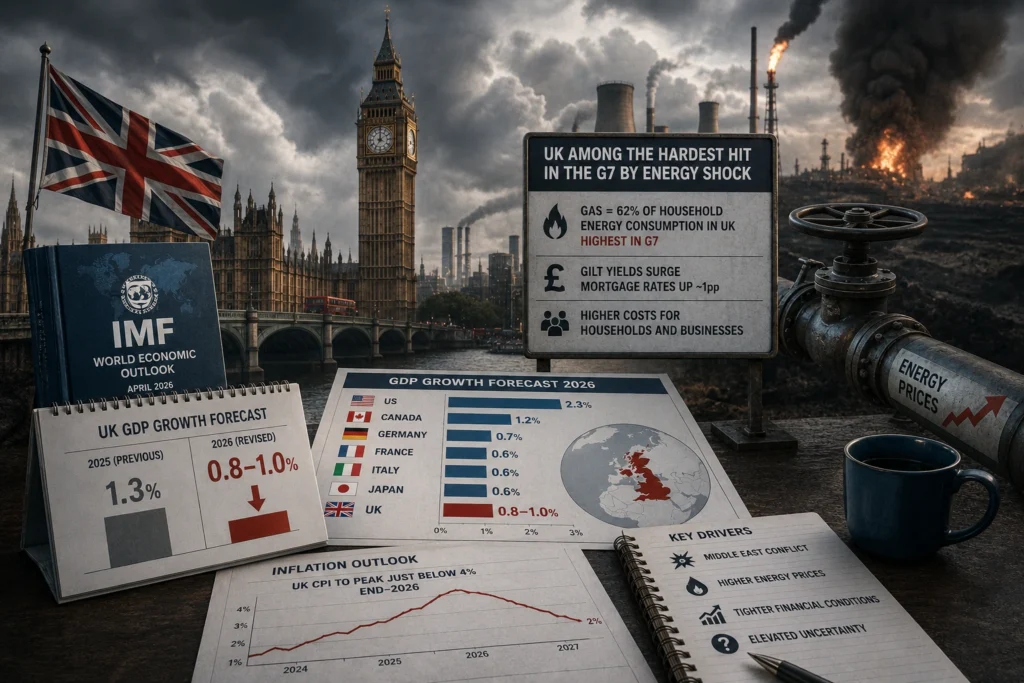
IMF Downgrades UK Growth Forecast to 0.8–1.0% for 2026 — BritainAmong the Hardest Hit in the G7 by Middle East Energy Shock

The International Monetary Fund has issued two successive assessments of the UK’s economicprospects since the outbreak of the Middle East conflict, both pointing to a significant deteriorationin the near-term outlook. In its April 2026 World Economic Outlook, the IMF cut the UK’s 2026GDP growth forecast from 1.3% to 0.8% — a downgrade of 0.5 percentage points, the largest ofany advanced economy alongside the OECD’s equivalent revision. A subsequent Article IV missionconcluded in May 2026 revised the projection slightly upward to 1.0%, reflecting stronger-than-expected Q1 GDP data of 0.6%, but the overall assessment remained sobering: higher energy priceswill dampen consumer spending and increase production costs, while tighter financial conditionsand elevated uncertainty weigh on investment.The severity of the UK’s exposure stems from two structural features. First, gas accounts for 62% offinal household energy consumption in Britain — by far the highest share in the G7 — and UKelectricity prices are closely tied to wholesale gas. Second, UK borrowing costs have provedunusually sensitive to the shock: 10-year gilt yields rose by more in March 2026 than in any otherG7 country except Italy, pushing up mortgage rates by around one percentage point and costing atypical first-time buyer approximately £100 extra per month on re-fixing. The IMF upgraded theUK’s near-term inflation outlook by more than any other G7 economy — a cumulative 1.5percentage points in the two years to end-2027 — making Britain’s policy trade-off betweeninflation control and growth support particularly acute.The IMF’s Article IV statement confirmed that headline CPI is projected to peak just below 4% byend-2026 before easing in the second half of 2027 and returning to the 2% target by year-end 2027.Against this backdrop, the Fund’s guidance on monetary policy was precise: holding Bank Rate atits current level of 3.75% for the remainder of 2026 should be sufficient to contain second-roundeffects and keep inflation expectations anchored — but the Bank of England should retain fullflexibility to move in either direction depending on incoming data, and stand ready to respondforcefully if wage-price dynamics prove stronger than anticipated.The global picture underscores how widely the shock has spread. IMF’s reference scenario — whichassumes a short-lived conflict and a moderate 19% rise in energy prices — puts global growth at3.1% for 2026, down from a pre-conflict forecast of 3.4%. Global headline inflation is projected at4.4%. In a severe scenario in which energy disruptions extend into 2027 and central banks areforced to raise rates, global growth could fall to 2% in both 2026 and 2027.Key Facts:IMF April WEO: UK 2026 GDP forecast cut from 1.3% to 0.8% — joint largestdowngrade among advanced economiesIMF Article IV (May 18, 2026): revised UK forecast to 1.0%, reflecting stronger Q1outturn; inflation to peak just below 4% end-2026, returning to 2% target by end-2027OECD (June 3, 2026): UK 2026 growth forecast 0.9%; 2027 forecast 1.1%; UK inflationexpected to peak in H2 2026UK structural vulnerability: gas = 62% of household energy consumption — highest inG7; electricity prices closely linked to wholesale gas Financial sensitivity: UK 10-year gilt yields rose more than all G7 peers except Italy inMarch 2026; mortgage rates up ~1pp; typical first-time buyer paying ~£100/month extraon re-fixingIMF inflation upgrade for UK: largest cumulative upward revision of any G7 economy(+1.5pp over 2026–27)IMF monetary policy guidance: hold Bank Rate at 3.75% through end-2026; sufficient toreturn inflation to target by end-2027; retain flexibility in both directionsGlobal IMF reference forecast: GDP 3.1% (2026), down from pre-conflict 3.4%; inflation4.4%IMF adverse scenario: global growth 2.5% (2026); severe scenario: 2.0% in both 2026and 2027OECD eurozone forecast: 1.1% (2026); US: 2.3% (down 0.1pp); MENA region: 1.9%(down 2pp)Pre-conflict UK forecast (OBR, March 2026): 1.1% growth; CPI to fall to 2.3% in 2026and 2.0% from 2027 — now significantly revised Expert Insight (SWRR Centre):The fact that the UK received the largest growth downgrade of any advanced economy from boththe IMF and the OECD — despite not being a party to the Middle East conflict — is a strikingillustration of how structural energy dependence translates into macroeconomic vulnerability.Britain’s combination of gas-heavy household energy, electricity pricing tied to wholesale gasmarkets, and stretched public finances creates a transmission mechanism for external shocks that ismore direct than most of its G7 peers. The 62% gas share of household energy consumption is not ashort-term feature; it is a long-standing structural characteristic that successive governments havediscussed but not resolved, and the current episode makes plain what the cost of that deferral lookslike in practice.The IMF’s monetary policy guidance — hold rates, but retain flexibility in both directions —reflects a genuinely difficult calibration. The energy shock simultaneously raises inflation andsuppresses growth, placing the Bank of England in the same stagflationary bind that central banksfaced in 2022 following Russia’s invasion of Ukraine, though from a starting position of lowerinflation and already-reduced rates. The IMF’s view that holding at 3.75% is “sufficient” to returninflation to target by end-2027 is conditional on energy prices following the reference scenario; inthe adverse or severe scenarios, that judgment would need to be revisited. The ResolutionFoundation’s observation that markets were already pricing in as many as three rate rises — wellbeyond the IMF’s guidance — illustrates the gap between official assessments and marketpositioning, and the potential for financial conditions to tighten independently of central bankdecisions if confidence erodes.Sources:IMF — “World Economic Outlook, April 2026: Global Economy in the Shadow of War,” April 14,2026IMF — “United Kingdom: Staff Concluding Statement of the 2026 Article IV Mission,” May 18,2026House of Commons Library — “GDP International Comparisons: Economic Indicators,” updatedJune 2026Resolution Foundation — “The Macroeconomic Policy Outlook Q2 2026,” June 2026Fortune — “IMF slashes global growth forecast, blaming war in the Middle East,” April 14, 2026 Office for Budget Responsibility — “Economic and Fiscal Outlook,” March 2026

IMF Downgrades UK Growth Forecast to 0.8–1.0% for 2026 — BritainAmong the Hardest Hit in the G7 by Middle East Energy Shock Read More »

uk lifelong learning entitlement 1536x1024

UK Lifelong Learning Entitlement: Applications Open September 2026 — The MostSignificant Reform to Post-18 Student Finance in a Generation

From September 2026, adults in England will be able to apply for funding under the LifelongLearning Entitlement (LLE) — a new student finance system that replaces the existingundergraduate student finance and Advanced Learner Loans for study at levels 4 to 6. Courses andmodules funded under the new system will begin from January 2027. The reform, described by theAssociation of Colleges as a potential “game changer,” creates a single, unified funding frameworkfor post-18 education that applies consistently across universities, further education colleges, andindependent training providers.The core of the LLE is a lifetime loan entitlement equivalent to four years of post-18 education —£39,160 based on 2026/27 fee rates — which learners can draw down flexibly across their entireworking lives, up to the age of 60. Unlike the existing system, which is structured around a singlecontinuous course of study typically taken in early adulthood, the LLE allows people to return toeducation multiple times, study part-time, complete individual modules, or mix full qualificationswith shorter courses, accumulating credits at a pace that fits their circumstances. Additionalentitlement is available for priority subjects and longer courses such as medicine and dentistry.The journey to this point has been long and repeatedly delayed. The LLE was first announced byBoris Johnson in 2020 as part of a Lifetime Skills Guarantee, and was originally due to launch inFebruary 2025 with the first cohort starting in September 2025. Delivery challenges led to twosignificant postponements, with the current September 2026 application window representing thethird scheduled launch date. The delays have drawn criticism from the further education sector,which has had to plan for a system that kept shifting. Three statutory instruments are currentlybefore Parliament to implement the fee limits and funding framework; the latter two are contingenton parliamentary approval of the first.One of the LLE’s most practically significant features is the removal of Equivalent or LowerQualification (ELQ) restrictions. Under the current system, people who already hold a level 6qualification (such as a degree) cannot generally access public funding to study anotherqualification at the same or lower level. The LLE removes this restriction, making it possible — forexample — for someone who studied humanities to retrain in software engineering or healthcare atpublic expense. This directly addresses one of the structural weaknesses of the current system: itsinability to fund mid-career retraining in response to technological change or economic disruption.Key Facts: Applications open: September 2026; courses and modules begin January 2027 onwards Entitlement: equivalent to four years of post-18 education — £39,160 (2026/27 rates);£38,140 at 2025/26 rates Age limit: available up to age 60 Replaces: undergraduate student finance and Advanced Learner Loans at levels 4, 5 and 6 inEngland Scope: full courses (degrees, Higher Technical Qualifications) and modules (minimum 30credits) at levels 4–6; priority subjects include digital, health, and green economy skills Modular funding: initially limited to Higher Technical Qualifications (HTQs) and level 6modules in priority skills areas aligned to the government’s industrial strategy ELQ restrictions removed: people with existing level 6 qualifications can now access publicfunding to retrain at the same or lower level Maintenance loans: available for courses with in-person attendance Digital account: learners will have a personal online account showing their remaining LLEbalance and eligible courses throughout their life Delivery: Student Loans Company (SLC) managing the new system on behalf of theDepartment for Education Legislative basis: Lifelong Learning (Higher Education Fee Limits) Act; three statutoryinstruments currently before Parliament History of delays: originally due to launch February 2025 (learners starting September2025); postponed twice due to delivery challenges IFS assessment (May 2026): LLE is the most significant structural reform to post-16education funding since the introduction of tuition feesExpert Insight (SWRR Centre):The LLE represents a genuine structural break with the way England has financed post-18education since the introduction of tuition fees in 1998. The existing system was designed around asingle, linear educational pathway — school, then university, then work — and has neverfunctioned well for adults who need to retrain, upskill, or return to formal education mid-career.The LLE explicitly rejects this linearity: by allowing the entitlement to be drawn downincrementally over a lifetime, it acknowledges that education is not a one-time event but an ongoingresponse to changing labour market conditions.The removal of ELQ restrictions is more significant than it might appear. In an economy where AI,automation, and the green transition are restructuring entire sectors, the ability to fund mid-careerretraining at public expense is not a marginal benefit — it is a structural prerequisite for labourmarket adaptability. The current ELQ restriction effectively penalised people who had alreadyinvested in education by making them ineligible for further public support precisely when the skillsthey originally acquired became less relevant. Removing it is a quiet but consequential policychange.The repeated delays are worth noting as a governance question in their own right. A reform firstannounced in 2020, originally due to launch in 2025, and now beginning in January 2027 has spentseven years in development — a timeline that spans three prime ministers, two general elections,and a change of governing party. The fact that both the Conservative and Labour governmentsmaintained the policy across that transition is evidence of cross-party consensus on the underlyingneed. But the implementation delays have meant that the further education sector has beenpreparing for a shifting target, and the statutory instruments still pending parliamentary approvalmean the system is not yet fully legislated even as the application window approaches. Whether theJanuary 2027 launch holds without further slippage will itself be a test of the government’sadministrative capacity.Sources:GOV.UK — “Lifelong learning entitlement: what it is and how it will work,” updated May 2026GOV.UK — “Lifelong learning entitlement (LLE): overview,” updated April 2026House of Commons Library — “The Lifelong Learning Entitlement,” CBP-9756, updated June2026Student Finance England — “Studying in 2027: Lifelong Learning Entitlement,” 2026Office for Students — “Modular provision and the lifelong learning entitlement,” updated March2026Institute for Fiscal Studies — “Funding, finance and reform: analysis of the post-16 education andskills White Paper,” May 2026

UK Lifelong Learning Entitlement: Applications Open September 2026 — The MostSignificant Reform to Post-18 Student Finance in a Generation Read More »