
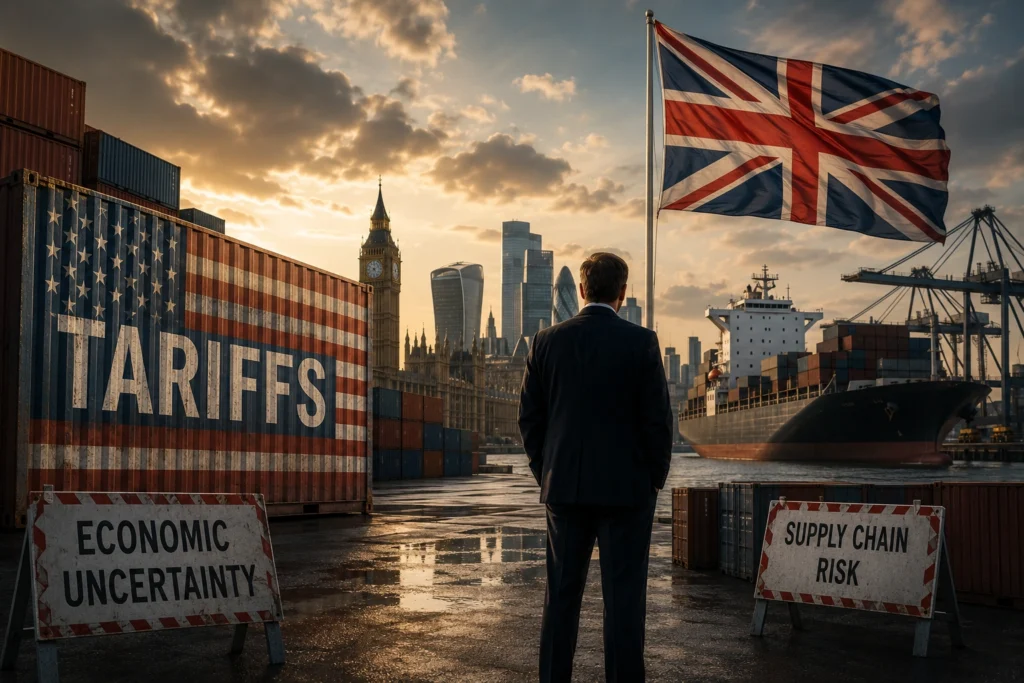
Since returning to office in January 2025, President Donald Trump has pursued the most sweeping
overhaul of US trade policy in a generation. A cascade of tariffs — on steel, aluminium,
automobiles, semiconductors, and a broad range of consumer goods — has fundamentally altered
the terms on which the United States engages with the global economy. For the United Kingdom, an
open economy historically dependent on predictable, rules-based international trade, the
implications are structural rather than merely transactional.
The scale of the tariff programme is without modern precedent. According to the Tax Foundation,
Trump’s tariffs constitute the largest US tax increase as a share of GDP since 1993, amounting to an
average additional burden of approximately 1,500 dollars per US household in 2026. The measures
include a 25% tariff on all steel and aluminium imports — raised to 50% in June 2025 — a 25%
tariff on passenger vehicles and automobile parts introduced in spring 2025, and a baseline 10%
tariff on most other imports following the US Supreme Court’s February 2026 ruling that the
broader reciprocal tariff framework exceeded presidential authority under emergency powers
legislation. That ruling changed the legal basis for the tariffs but did not remove them: the
administration promptly reimposed a 10% global tariff under alternative statutory authority, valid
for 150 days pending potential congressional extension.
The direct exposure for the UK is concentrated in several sectors. Steel and aluminium exports to
the US face a combined tariff of 35% — the 10% baseline stacked on top of the 25% sector-specific
rate — with the UK having missed the July 2025 deadline to negotiate a tailored exemption under
the UK-US Economic Prosperity Deal. Roughly half of the 37,000 jobs in the UK steel industry are
located in Wales and Yorkshire and the Humber, making the tariff’s geographic impact highly
concentrated. On pharmaceuticals — the UK’s second-largest goods export to the United States — a
separate deal reached in October 2025 averted immediate tariffs, though it required the UK to raise
NHS drug prices and increase NHS spending, concessions that carry their own domestic
implications. Automobiles remain subject to 25% tariffs, with negotiations ongoing.
The broader economic impact on the UK has been measured but real. The Office for Budget
Responsibility forecast in November 2025 that UK export markets would grow more slowly over
the following four years and that global trade intensity would fall. The OECD revised its UK
growth forecast downward partly on the basis of the trade policy environment. Research on tariff
pass-through from the first Trump administration indicates that the cost of tariffs is borne
overwhelmingly by importing businesses and consumers in the receiving country — not, as the
White House has argued, by the exporting nation. A 20% tariff translates into roughly an 18.5%
increase in import prices, most of which is either absorbed by firms as reduced margins or passed
on to consumers as higher prices.
The wider significance extends beyond bilateral trade economics. The Trump administration’s
willingness to deploy tariffs as a geopolitical instrument — including a January 2026 announcement
of 10% tariffs on European countries opposing US plans over Greenland, with a threat to raise them
to 25% — signals a qualitative shift in how economic leverage is being used by major powers.
Chatham House has described this as the emergence of an era of economic coercion, in which trade
policy is increasingly detached from rules-based norms and deployed in service of geopolitical
objectives that may have little connection to trade imbalances. For the UK, outside the EU and
therefore without the collective bargaining weight of a major trade bloc, managing this environment
bilaterally presents structural vulnerabilities that no single deal can fully resolve.
Key Facts:
Trump’s tariffs represent the largest US tax increase as a share of GDP since 1993; estimated
at an average of 1,500 dollars per US household in 2026
UK steel and aluminium exports face a combined 35% tariff rate; steel industry employs
approximately 37,000 people in the UK, concentrated in Wales and Yorkshire
A 10% baseline tariff on most UK goods remains in place following the February 2026
Supreme Court ruling, reimposed under alternative statutory authority
The OBR forecast in November 2025 that UK export market growth would slow over the
next four years as a result of the global trade environment
A UK-US pharmaceuticals deal in October 2025 averted immediate tariffs but required the
UK to raise NHS drug prices
Research shows that approximately 80–85% of US tariff costs are absorbed domestically by
US businesses or passed on to US consumers — not paid by the exporting country
The Tax Foundation estimates that retaliatory tariffs already affect more than 223 billion
dollars of US exports globally
Expert Insight (SWRR Centre)
The Trump tariff regime matters for SWRR Centre’s research agenda not primarily as a trade policy
story but as an example of how economic systems come under stress when the institutional rules
governing them are contested or abandoned by a dominant actor.
The rules-based international trading order — built through decades of multilateral negotiation —
functions as a form of systemic resilience infrastructure. It reduces uncertainty, enables long-term
investment planning, and distributes the costs of economic adjustment through agreed mechanisms
rather than unilateral power. When a state of the United States’ scale exits that framework
selectively and unpredictably, the resulting uncertainty is itself a form of structural damage —
visible in the OBR’s downgraded forecasts, in corporate supply chain restructuring, and in the
diplomatic energy being consumed by economies like the UK’s in managing bilateral exposure
rather than pursuing growth.
For the UK specifically, the tariff environment illuminates a vulnerability that predates Trump: the
absence of collective bargaining weight following EU exit. The EU has responded to US tariffs with
coordinated countermeasures and negotiating leverage derived from market scale. The UK has
navigated the same environment through bilateral deal-making, accepting concessions — on NHS
drug pricing, on steel quotas — that reflect an asymmetric negotiating position. This is not an
argument about the merits of any particular trade arrangement; it is an observation about how
structural position shapes resilience when external economic shocks arrive. The current episode
offers a well-documented case study in economic exposure and adaptive capacity that will remain
analytically relevant long after the specific tariff rates have changed.
Sources
House of Commons Library, US Trade Tariffs, updated June 2026:
https://commonslibrary.parliament.uk/research-briefings/cbp-10240/
Economics Observatory, The UK-US Trade Deal: What Will Be the Effects?
https://www.economicsobservatory.com/the-uk-us-trade-deal-what-will-be-the-effects
Chatham House, Trump’s Greenland Tariffs Show the UK Must Prepare for a New Era of Economic Coercion, January 2026:
https://www.chathamhouse.org/2026/01/trumps-greenland-tariffs-show-uk-must-prepare-new-era-economic-coercionInstitute for Government, Tariffs, Trade and Trump:
https://www.instituteforgovernment.org.uk/explainer/trade-tariffs
Tax Foundation, Tariff Tracker: 2026 Trump Tariffs and Trade War by the Numbers, May 2026:
https://taxfoundation.org/research/all/federal/trump-tariffs-trade-war/