
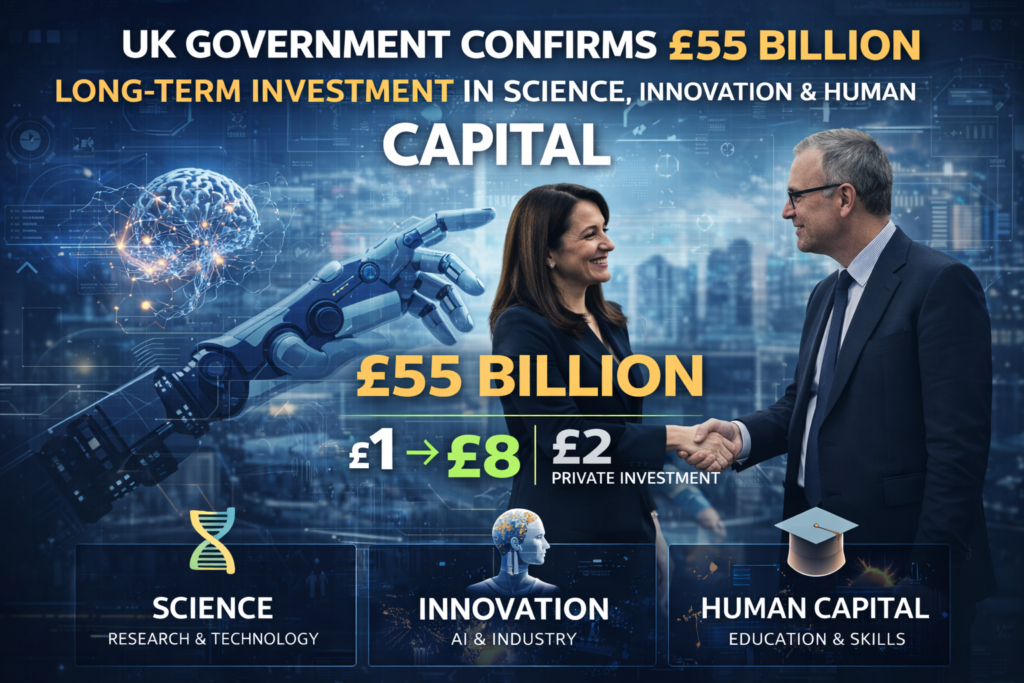
On October 30, 2025, the Department for Science, Innovation and Technology (DSIT) confirmed a record £55 billion investment in research and development through to 2029/30, marking the largest-ever funding managed by DSIT. The department’s overall R&D budget will grow to £58.5 billion, representing a real-terms increase over the Spending Review period.
This announcement forms part of a wider £86 billion public R&D package confirmed by the Chancellor at the Spending Review. New government analysis demonstrates that every £1 of public investment in R&D generates £8 in wider economic benefits and attracts an additional £2 in private sector funding, highlighting significant returns for the economy.
Science and Technology Secretary Liz Kendall announced the allocations during a visit to IBM’s London headquarters, where she witnessed how private investment supports public R&D programmes spanning quantum computing to robotics and artificial intelligence. The largest share of funding – £38.6 billion – will go to UK Research and Innovation (UKRI), the national agency responsible for supporting universities, research institutes, and innovation-led businesses.
Alongside technological investment, the government recognized the critical importance of human capital. In June 2025, the TechFirst programme launched with £187 million to embed digital and AI capabilities into education and workforce development pathways. Additionally, £1.2 billion annually is allocated for apprenticeships and training, particularly in digital, health and green sectors.
Key Facts:
- Total funding: £55bn for R&D (2026-2030), with DSIT’s overall budget reaching £58.5bn
- UKRI: £38.6bn, including nearly £10bn in 2029/30
- ARIA (high-risk research): £400m annually by 2029/30 (up from £220m)
- National institutions: Met Office £1.4bn, National Academies £900m, National Measurement System £550m
- AI Security Institute: £240m
- Economic returns: Every £1 → £8 economic benefit + £2 private investment
- Business impact: 6 years after first R&D grant, employment rises 21%, turnover grows 23%
- Human capital: TechFirst £187m for digital skills; £1.2bn annually for apprenticeships
- Computing power: £750m for national supercomputing service in Edinburgh; £1bn from DSIT to expand UK compute capacity twenty-fold
Expert Insight (SWRR Centre):
“The £55 billion R&D announcement with explicit emphasis on human capital signals an important shift in UK economic strategy – recognition that technological breakthroughs and economic resilience are inseparable from investment in people. This is particularly relevant for post-conflict recovery research.
The integration of the £187 million TechFirst programme within the broader R&D package demonstrates understanding: innovation is impossible without prepared personnel. The government is not merely funding laboratories – it is building an ecosystem where technological development is accompanied by skills development from school age through postgraduate education.
From the perspective of a research center focused on recovery, this creates a useful model. Economic resilience and post-conflict recovery require not only physical reconstruction or technological equipment, but parallel investments in education, training and scientific capacity. The UK ‘tech + talent’ model can inform approaches to post-conflict recovery in Ukraine, where infrastructure must be rebuilt AND a generation of specialists capable of managing that rebuilt infrastructure must be prepared simultaneously.
It is also significant that £8 in economic benefits for every £1 invested demonstrates that spending on science and human capital is not expenditure but strategic investment with measurable returns. For donor countries like Britain, this model confirms capacity to sustain long-term international commitments, including support for Ukraine, as investment in innovation generates economic growth that finances both domestic needs and external partnerships.
The inclusion of £240 million for the AI Security Institute also indicates recognition that technological resilience includes security – a lesson exceptionally relevant to post-conflict contexts where cyber threats and technological vulnerabilities can undermine recovery efforts.”
Sources:
UK Government (DSIT) – “£55 billion R&D funding boost to unlock UK breakthroughs”, 30 October 2025
UK Research and Innovation – Budget allocations explainer, 30 October 2025
Department for Science, Innovation and Technology – R&D plans to 2029/2030
UK Government – TechFirst Programme announcement, June 2025
Business Matters – Interview with Liz Kendall, 31 October 2025