
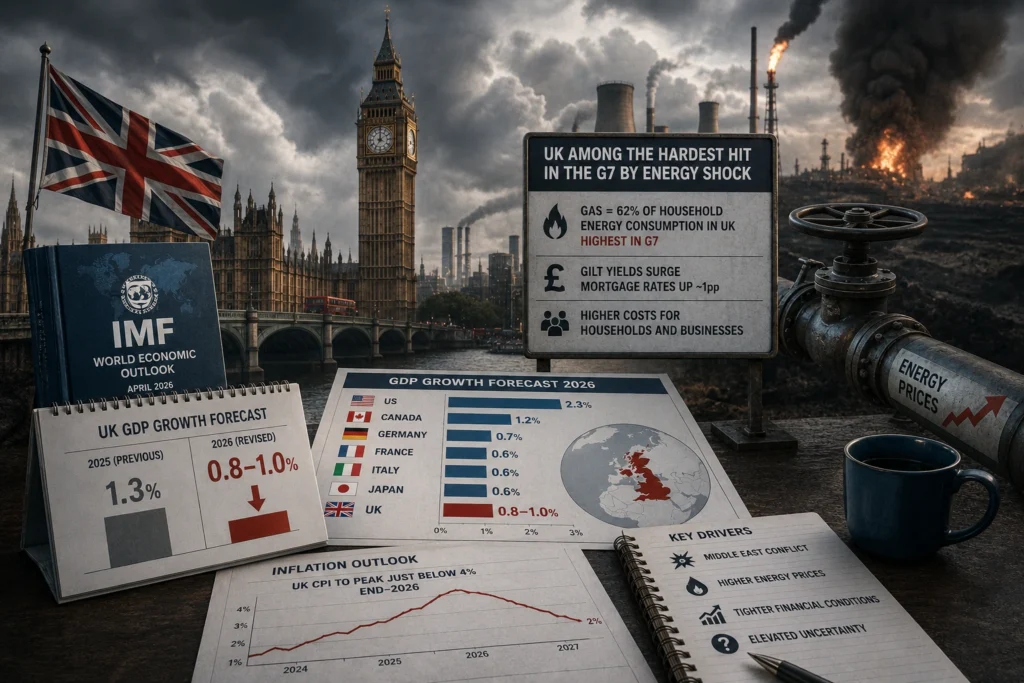
The International Monetary Fund has issued two successive assessments of the UK’s economic
prospects since the outbreak of the Middle East conflict, both pointing to a significant deterioration
in the near-term outlook. In its April 2026 World Economic Outlook, the IMF cut the UK’s 2026
GDP growth forecast from 1.3% to 0.8% — a downgrade of 0.5 percentage points, the largest of
any advanced economy alongside the OECD’s equivalent revision. A subsequent Article IV mission
concluded in May 2026 revised the projection slightly upward to 1.0%, reflecting stronger-than-
expected Q1 GDP data of 0.6%, but the overall assessment remained sobering: higher energy prices
will dampen consumer spending and increase production costs, while tighter financial conditions
and elevated uncertainty weigh on investment.
The severity of the UK’s exposure stems from two structural features. First, gas accounts for 62% of
final household energy consumption in Britain — by far the highest share in the G7 — and UK
electricity prices are closely tied to wholesale gas. Second, UK borrowing costs have proved
unusually sensitive to the shock: 10-year gilt yields rose by more in March 2026 than in any other
G7 country except Italy, pushing up mortgage rates by around one percentage point and costing a
typical first-time buyer approximately £100 extra per month on re-fixing. The IMF upgraded the
UK’s near-term inflation outlook by more than any other G7 economy — a cumulative 1.5
percentage points in the two years to end-2027 — making Britain’s policy trade-off between
inflation control and growth support particularly acute.
The IMF’s Article IV statement confirmed that headline CPI is projected to peak just below 4% by
end-2026 before easing in the second half of 2027 and returning to the 2% target by year-end 2027.
Against this backdrop, the Fund’s guidance on monetary policy was precise: holding Bank Rate at
its current level of 3.75% for the remainder of 2026 should be sufficient to contain second-round
effects and keep inflation expectations anchored — but the Bank of England should retain full
flexibility to move in either direction depending on incoming data, and stand ready to respond
forcefully if wage-price dynamics prove stronger than anticipated.
The global picture underscores how widely the shock has spread. IMF’s reference scenario — which
assumes a short-lived conflict and a moderate 19% rise in energy prices — puts global growth at
3.1% for 2026, down from a pre-conflict forecast of 3.4%. Global headline inflation is projected at
4.4%. In a severe scenario in which energy disruptions extend into 2027 and central banks are
forced to raise rates, global growth could fall to 2% in both 2026 and 2027.
Key Facts:
IMF April WEO: UK 2026 GDP forecast cut from 1.3% to 0.8% — joint largest
downgrade among advanced economies
IMF Article IV (May 18, 2026): revised UK forecast to 1.0%, reflecting stronger Q1
outturn; inflation to peak just below 4% end-2026, returning to 2% target by end-2027
OECD (June 3, 2026): UK 2026 growth forecast 0.9%; 2027 forecast 1.1%; UK inflation
expected to peak in H2 2026
UK structural vulnerability: gas = 62% of household energy consumption — highest in
G7; electricity prices closely linked to wholesale gas
Financial sensitivity: UK 10-year gilt yields rose more than all G7 peers except Italy in
March 2026; mortgage rates up ~1pp; typical first-time buyer paying ~£100/month extra
on re-fixing
IMF inflation upgrade for UK: largest cumulative upward revision of any G7 economy
(+1.5pp over 2026–27)
IMF monetary policy guidance: hold Bank Rate at 3.75% through end-2026; sufficient to
return inflation to target by end-2027; retain flexibility in both directions
Global IMF reference forecast: GDP 3.1% (2026), down from pre-conflict 3.4%; inflation
4.4%
IMF adverse scenario: global growth 2.5% (2026); severe scenario: 2.0% in both 2026
and 2027
OECD eurozone forecast: 1.1% (2026); US: 2.3% (down 0.1pp); MENA region: 1.9%
(down 2pp)
Pre-conflict UK forecast (OBR, March 2026): 1.1% growth; CPI to fall to 2.3% in 2026
and 2.0% from 2027 — now significantly revised
Expert Insight (SWRR Centre):
The fact that the UK received the largest growth downgrade of any advanced economy from both
the IMF and the OECD — despite not being a party to the Middle East conflict — is a striking
illustration of how structural energy dependence translates into macroeconomic vulnerability.
Britain’s combination of gas-heavy household energy, electricity pricing tied to wholesale gas
markets, and stretched public finances creates a transmission mechanism for external shocks that is
more direct than most of its G7 peers. The 62% gas share of household energy consumption is not a
short-term feature; it is a long-standing structural characteristic that successive governments have
discussed but not resolved, and the current episode makes plain what the cost of that deferral looks
like in practice.
The IMF’s monetary policy guidance — hold rates, but retain flexibility in both directions —
reflects a genuinely difficult calibration. The energy shock simultaneously raises inflation and
suppresses growth, placing the Bank of England in the same stagflationary bind that central banks
faced in 2022 following Russia’s invasion of Ukraine, though from a starting position of lower
inflation and already-reduced rates. The IMF’s view that holding at 3.75% is “sufficient” to return
inflation to target by end-2027 is conditional on energy prices following the reference scenario; in
the adverse or severe scenarios, that judgment would need to be revisited. The Resolution
Foundation’s observation that markets were already pricing in as many as three rate rises — well
beyond the IMF’s guidance — illustrates the gap between official assessments and market
positioning, and the potential for financial conditions to tighten independently of central bank
decisions if confidence erodes.
Sources:
IMF — “World Economic Outlook, April 2026: Global Economy in the Shadow of War,” April 14,
2026
IMF — “United Kingdom: Staff Concluding Statement of the 2026 Article IV Mission,” May 18,
2026
House of Commons Library — “GDP International Comparisons: Economic Indicators,” updated
June 2026
Resolution Foundation — “The Macroeconomic Policy Outlook Q2 2026,” June 2026
Fortune — “IMF slashes global growth forecast, blaming war in the Middle East,” April 14, 2026
Office for Budget Responsibility — “Economic and Fiscal Outlook,” March 2026