
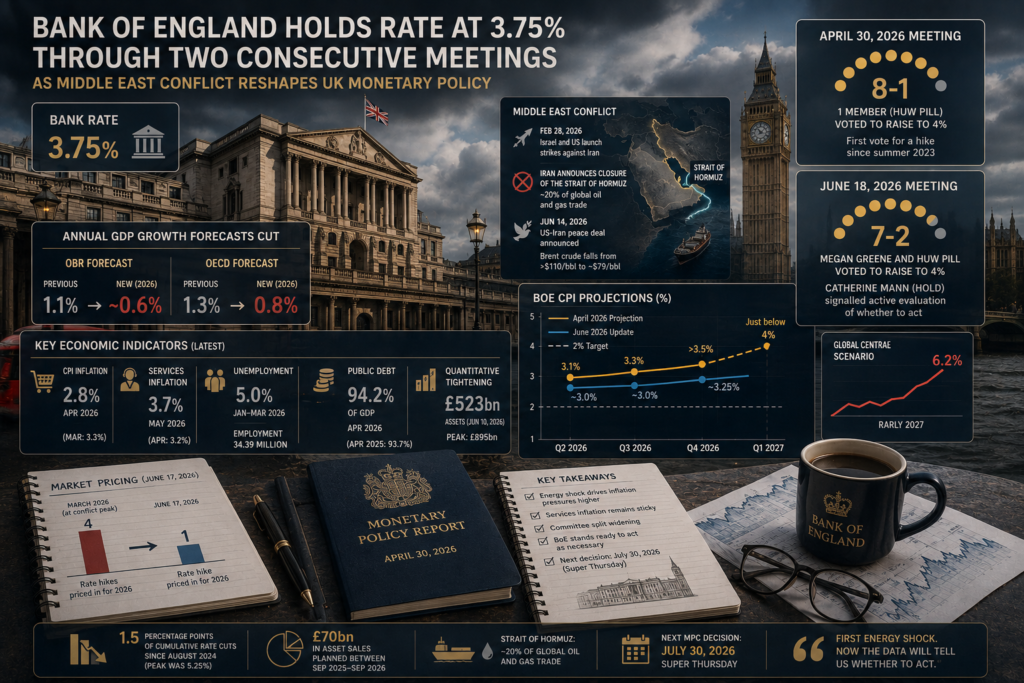
The Bank of England’s Monetary Policy Committee held Bank Rate at 3.75% at both its April 30 and June 18 meetings, but the picture behind the headline decision has shifted materially between the two. The April vote was 8-1, with a single hawkish dissent — the first vote for a rate increase since the tightening cycle ended in summer 2023. By June, that dissent had grown to 7-2, with Megan Greene and Huw Pill both voting to raise rates to 4%, while a third member, Catherine Mann, indicated in her published rationale that she is actively evaluating whether to act. The direction of travel within the committee is clear: the question is no longer whether the MPC will maintain its dovish stance indefinitely, but whether the data will force a move before the year is out.
The context for both decisions is the energy shock triggered by the Middle East conflict. Following Israeli and US strikes on Iran on February 28, 2026, and the subsequent closure of the Strait of Hormuz, oil and gas prices rose sharply, upending the Bank’s pre-conflict projections. Before the conflict, the Bank expected CPI inflation to fall to around 2% from April 2026 and remain close to target for the rest of the year. In its April Monetary Policy Report, the Bank revised those projections significantly upward: CPI was now projected at 3.1% in Q2, 3.3% in Q3, and rising further in Q4, with the Bank’s adverse scenario placing peak inflation just below 4% in early 2027.
A worst-case scenario put the figure at 6.2%.
The June meeting was shaped by two new developments. First, on June 14 — four days before the vote — the United States and Iran announced a peace deal, and Brent crude oil fell sharply from above $110 per barrel to around $79. This eased the near-term inflation outlook sufficiently to keep
the majority on hold. Second, May CPI data, released on June 17, held at 2.8% — below expectations — though services inflation ticked back up to 3.7%, maintaining the committee’s concern about domestic price pressure. The June minutes noted that global energy prices “remain higher than pre-conflict and have continued to be volatile,” and that “the impact of the energy shock on the UK economy remains uncertain.” The Bank stated it “stands ready to act as necessary” and confirmed the next Monetary Policy Report — a “Super Thursday” — will be published alongside the July 30 decision.
Market pricing has oscillated sharply across the period. At the height of the conflict in March, markets were pricing as many as four rate hikes in 2026. By June 17, that had fallen to roughly one hike priced in for the year. Economist forecasts diverge widely: Bank of America expects hikes in
July and September; ING pencils in a “one-and-done” rise this summer; Oxford Economics expects no change through 2026 and well into 2027; Pantheon Macroeconomics and Deutsche Bank have both removed their hike forecasts following the ceasefire. On quantitative tightening, the MPC is reducing its asset holdings from a peak of £895 billion to £523 billion, with £70 billion in sales planned between September 2025 and September 2026.
Key Facts:
- Bank Rate: held at 3.75% at both April 30 (8-1) and June 18 (7-2) MPC meetings
- April dissent: one member (Huw Pill) voted to raise to 4% — first vote for a hike since summer 2023
- June dissents: Megan Greene and Huw Pill voted to raise to 4%; Catherine Mann (hold) signalled active evaluation of whether to act; seven members voted to hold
- BoE April Monetary Policy Report projections: CPI 3.1% (Q2), 3.3% (Q3), rising further Q4; adverse scenario: peak just below 4% in early 2027; worst case: 6.2%
- June update: CPI expected “a little under 3% in Q3” and “a little over 3.25% in Q4” — lower than April projections following energy price fall
- Key event between meetings: US-Iran peace deal announced June 14; Brent crude fell from above $110/bbl to ~$79/bbl
- May CPI: 2.8% (held flat vs April); services inflation: 3.7% (up from 3.2% in April) — primary MPC concern
- Market pricing (June 17): approximately one hike priced in for 2026; down from four hikes priced in March
- Pre-conflict expectation: two rate cuts in 2026; now replaced by hold-or-hike scenario
- Cumulative rate cuts since August 2024: 1.5 percentage points (from 5.25% peak)
- Quantitative tightening: asset holdings reduced from £895bn peak to £523bn (as of June 10); £70bn in sales planned to September 2026
- ECB contrast: raised deposit rate to 2.25% on June 11 — diverging from BoE’s hold
- Next decision: July 30, 2026 — Super Thursday with updated Monetary Policy Report and
- press conference
Expert Insight (SWRR Centre):
The shift from an 8-1 to a 7-2 vote in six weeks, against a backdrop in which the peace deal has reduced near-term energy price pressure, is a striking illustration of how rapidly monetary policy committees can move from apparent consensus to active internal disagreement. The headline
decision — hold — is the same on both dates. But the MPC communicating through the vote split and published individual rationales is a different instrument from the headline rate, and the June minutes are meaningfully more hawkish than April’s despite energy prices having fallen in the interim. The explanation lies in services inflation: at 3.7% in May and moving in the wrong direction, domestic price pressure is providing a basis for hawkish dissent that is independent of the energy shock itself.
The divergence between the BoE and the ECB is worth tracking as a structural observation. The ECB raised rates on June 11 — citing Middle East-generated inflation — while the BoE held a week later, citing the same conflict but emphasising the uncertainty and the loosening labour market. Both are responding to the same external shock; the different decisions reflect different institutional risk assessments, different labour market dynamics, and different fiscal contexts. For anyone studying how institutions respond to shared external pressures, this is a live natural experiment: two central banks, one shock, diverging policy paths.
The peace deal’s impact on the June decision also illustrates a recurring challenge for central banks operating in geopolitically volatile environments: the data used to justify a decision can shift materially between the deliberations and the announcement, let alone between the announcement and the next meeting. The MPC’s emphasis on “monitoring closely the situation in the Middle East” and standing “ready to act as necessary” is not boilerplate — it is an acknowledgement that the standard six-week deliberation cycle is poorly matched to the speed at which geopolitical conditions can move.
Sources:
Bank of England — “Bank Rate maintained at 3.75% — June 2026 Monetary Policy Summary and Minutes,” June 18, 2026
Bank of England — “Monetary Policy Report,” April 30, 2026
House of Commons Library — “Interest rates and monetary policy: Economic indicators,” updated June 18, 2026
HomeOwners Alliance — “Latest UK Interest Rate Forecasts,” updated June 18, 2026
BritSavvy — “Bank of England June 2026 — Hold at 3.75%. What It Means,” June 18, 2026
Cambridge Currencies — “UK Interest Rate Forecast 2026: Next Bank of England Decision,” updated June 2026
CNBC — “Bank of England April 2026 interest rate decision,” April 30, 2026