
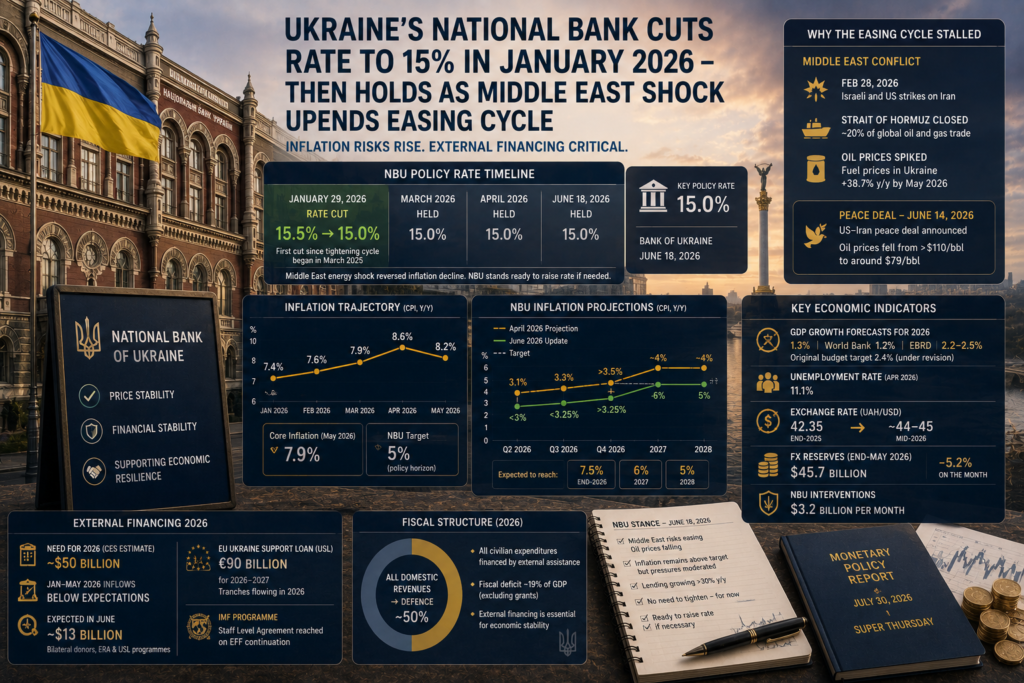
On January 29, 2026, the National Bank of Ukraine (NBU) cut its key policy rate by 50 basis points — from 15.5% to 15% — marking the start of what was expected to be a gradual monetary easing cycle. The decision reflected a sustained decline in inflationary pressures through late 2025: consumer and core inflation had slowed to 8% year-on-year in December, driven by a strong harvest season, easing labour market pressures, and a stable foreign exchange market. Crucially, the EU Council’s late-2025 decision to provide Ukraine with €90 billion in financial assistance over 2026–2027 — the Ukraine Support Loan — had materially reduced the external financing risks that had kept the NBU on hold for seven consecutive meetings since March 2025. With reserves at $57.3 billion at end-2025, the NBU judged conditions sufficient to begin easing.
That easing cycle stalled almost immediately. The outbreak of the Middle East conflict in late February 2026, and the subsequent closure of the Strait of Hormuz, pushed global oil and fuel prices sharply higher. Ukraine, heavily dependent on imported fuel, saw fuel prices rise 38.7% year-
on-year by May 2026. CPI inflation, which had been expected to decline steadily toward the NBU’s 5% target, instead reversed course: from 7.4% in January, inflation rose to 7.9% in March, 8.6% in April, and 8.2% in May. Core inflation accelerated to 7.9% in May — both figures above the NBU’s April forecast trajectory, primarily due to second-round effects of energy price growth. The NBU held rates at 15% at its March, April, and June meetings, each time citing rising inflationary risks and signalling readiness to raise rates if underlying price pressures intensified.
The external financing picture — always the most consequential variable in Ukraine’s wartime macroeconomic framework — also became more strained in early 2026. The Centre for Economic Strategy estimates Ukraine’s external financing need for 2026 at approximately $50 billion. All domestic budget revenues go to financing defence, which accounts for roughly half of total expenditures; all civilian expenditures are covered by external assistance. The fiscal deficit runs at approximately 19% of GDP excluding grants, and is structurally dependent on the continuity of international support. External financing in January–May 2026 came in below expectations, though the NBU expects a significant catch-up in June: Ukraine is expected to receive approximately $13 billion in June alone, from bilateral donors and under the ERA (Extraordinary Revenue Acceleration) and USL programmes. Progress in IMF negotiations — a Staff Level Agreement was reached — is an important signal for future EFF (Extended Fund Facility) tranches. International reserves declined to $45.7 billion at end-May 2026, with the NBU intervening at $3.2 billion per month to support the hryvnia. The official exchange rate depreciated gradually from UAH 42.35 per dollar at end-2025 to approximately UAH 44–45 per dollar by mid-2026, under the NBU’s managed flexibility regime.
At its June 18 meeting, the NBU held the rate at 15% but shifted its tone slightly: with oil prices falling following the US–Iran peace deal announced on June 14, the NBU noted that easing Middle East risks and lower global energy prices should reduce Ukraine’s energy import costs and help contain inflation. It noted growing lending volumes — credit is expanding at over 30% annually — as evidence that monetary conditions are not impeding economic activity, and confirmed that it currently sees no need to tighten policy while also standing ready to raise rates if necessary.
Key Facts:
- NBU rate cut: 50 basis points, from 15.5% to 15%, effective January 30, 2026 — first cut since the tightening cycle began in March 2025
- Subsequent decisions: held at 15% at March, April, and June 18 meetings — easing cycle suspended due to Middle East energy shock
- January rationale: declining inflation (8% y/y Dec 2025), strong harvest effects, stable FX, reduced external financing risk following EU €90bn loan commitment
- EU Ukraine Support Loan (USL): €90 billion for 2026–2027, decided late 2025; first tranches flowing in 2026
- Inflation trajectory: 7.4% (Jan) → 7.9% (Mar) → 8.6% (Apr) → 8.2% (May 2026); fuel prices +38.7% y/y by May; core inflation 7.9% (May)
- NBU inflation target: 5% over the policy horizon; now expected to reach 7.5% at end-2026, 6% in 2027, 5% in 2028
- Fiscal structure: all domestic revenues fund defence (approximately 50% of budget); all civilian expenditures financed by external assistance; fiscal deficit approximately 19% of GDP excluding grants
- External financing need 2026: approximately $50 billion (CES estimate); January–May inflows below expectations; approximately $13 billion expected in June
- IMF: Staff Level Agreement reached on EFF continuation — important signal for ongoing financing
- FX reserves: $45.7 billion (end-May 2026), down 5.2% on the month; NBU FX interventions $3.2 billion per month
- Exchange rate: UAH 42.35 per dollar (end-2025) to approximately UAH 44–45 per dollar (mid-2026); managed depreciation under flexibility regime
- GDP growth forecasts for 2026: NBU 1.3%; World Bank 1.2%; EBRD 2.2–2.5%; original budget target 2.4% (under revision)
- June 18 signal: NBU noted easing Middle East risks and falling oil prices as factors reducing inflation pressure; no rate change but tone slightly less hawkish
Expert Insight (SWRR Centre):
Ukraine’s monetary policy in 2026 illustrates a pattern that is structurally distinct from conventional central banking: the NBU is simultaneously managing inflation, exchange rate stability, and the confidence of external financing partners — each with different and sometimes conflicting requirements. The January cut was possible precisely because the EU loan commitment had reduced external financing uncertainty, allowing the NBU to prioritise the growth-supporting dimension of its mandate. The subsequent hold was imposed not by domestic data deteriorating but by an external shock — the Middle East conflict — feeding into fuel prices and inflation expectations before the domestic easing had meaningfully begun. The result is a central bank that cut once, then spent five months explaining why it cannot cut again.
The structural dependence on external financing deserves particular attention as a governance and resilience question. Ukraine’s fiscal framework is essentially bifurcated: the state raises domestic revenues for defence, and international partners fund everything else. This arrangement has held through four years of full-scale war, but it creates a specific vulnerability — the continuity of civilian public services, infrastructure maintenance, and social protection is directly contingent on the political decisions of donor governments and the disbursement calendars of multilateral institutions. The January–May financing shortfall, and the expectation of a $13 billion catch-up in June, illustrates how this contingency plays out in practice: budget execution becomes a function of external disbursement timing, not domestic revenue planning.
The NBU’s management of the exchange rate under managed flexibility — maintaining a gradual, controlled depreciation rather than a fixed peg or free float — is one of the more consequential institutional choices in Ukraine’s wartime economic management. It preserves competitiveness signals, avoids the credibility cost of a sudden devaluation, and maintains the NBU’s ability to intervene when needed. At $45.7 billion, reserves remain above the threshold typically considered adequate for this regime, but the monthly intervention pace of $3.2 billion is not sustainable
indefinitely if external financing inflows remain irregular. The June peace deal in the Middle East, y easing fuel price pressures, has provided some relief to this equation — but the NBU’s own caution about readiness to raise rates signals that the relief is not yet treated as durable.
Sources:
National Bank of Ukraine — “NBU Cuts Key Policy Rate to 15%,” January 29, 2026
National Bank of Ukraine — “NBU Leaves Its Key Policy Rate Unchanged at 15%,” June 18, 2026
Centre for Economic Strategy — “Ukraine War Economy Tracker,” updated June 2026
EBRD — “Ukraine maintains macroeconomic stability despite war,” Regional Economic Prospects, February 2026
Ukrainian Institute for the Future — “Macroeconomic Digest of Ukraine January 2026”
Interfax Ukraine — “Ukraine’s central bank leaves key policy rate unchanged at 15%,” June 18, 2026