
News

321

UK GDP Falls 0.1% in October – First Three-Month Decline Since 2023

UK GDP Falls 0.1% in October – First Three-Month Decline Since 2023 The UK Office for National Statistics (ONS) published data today showing real GDP declined 0.1% in the three months to October 2025 compared to the three months to July. This marks the first three-month fall since December 2023, driven by significant contractions in manufacturing and construction amid rising unemployment. The services sector showed no growth, while production fell 0.5% and construction dropped 0.3%. The largest contributor to the GDP decline was a 17.7% fall in motor vehicle manufacturing, partially attributed to a cyberattack on Jaguar Land Rover. Meanwhile, unemployment rose to 5.1% in the August-October 2025 period – the highest level since 2021. Despite these headwinds, the UK banking system remains resilient. Bank of England stress tests confirmed that financial institutions are well-capitalized and capable of supporting the economy even under adverse conditions. However, the Financial Policy Committee reduced systemic capital buffer requirements from 14% to 13% of risk-weighted assets to support lending during the economic slowdown. Key Facts: Expert Insight (SWRR Centre): A donor country’s economic resilience directly determines the scale and duration of its international recovery commitments. The Bank of England’s stress test results confirm that UK financial institutions can maintain support even under adverse conditions – this is critical for multi-year reconstruction projects such as support for Ukraine. However, the concurrent rise in unemployment and GDP contraction creates tension between domestic needs and external commitments. The ‘financial stability as foundation’ principle underpins our research on how donor country economic health determines their capacity to provide sustained assistance. A well-capitalized banking sector is not merely domestic infrastructure – it is the bedrock that enables Britain to function as a reliable partner in international reconstruction efforts, providing both direct financing and guarantees for development projects. Balancing fiscal consolidation with maintaining capacity for international aid will be a key challenge in 2026. Sources: Office for National Statistics (ONS) – GDP monthly estimate, UK: October 2025 Bank of England – Financial Stability Report, December 2025 Bank of England – Financial Policy Committee Record, October 2025 Reuters Economic Analysis, December 2025

UK GDP Falls 0.1% in October – First Three-Month Decline Since 2023 Read More »

chatgpt image 19 січ. 2026 р., 16 53 13

UK Government Confirms £55 Billion Long-Term Investment in Science, Innovation and Human Capital

On October 30, 2025, the Department for Science, Innovation and Technology (DSIT) confirmed a record £55 billion investment in research and development through to 2029/30, marking the largest-ever funding managed by DSIT. The department’s overall R&D budget will grow to £58.5 billion, representing a real-terms increase over the Spending Review period. This announcement forms part of a wider £86 billion public R&D package confirmed by the Chancellor at the Spending Review. New government analysis demonstrates that every £1 of public investment in R&D generates £8 in wider economic benefits and attracts an additional £2 in private sector funding, highlighting significant returns for the economy. Science and Technology Secretary Liz Kendall announced the allocations during a visit to IBM’s London headquarters, where she witnessed how private investment supports public R&D programmes spanning quantum computing to robotics and artificial intelligence. The largest share of funding – £38.6 billion – will go to UK Research and Innovation (UKRI), the national agency responsible for supporting universities, research institutes, and innovation-led businesses. Alongside technological investment, the government recognized the critical importance of human capital. In June 2025, the TechFirst programme launched with £187 million to embed digital and AI capabilities into education and workforce development pathways. Additionally, £1.2 billion annually is allocated for apprenticeships and training, particularly in digital, health and green sectors. Key Facts: Expert Insight (SWRR Centre): “The £55 billion R&D announcement with explicit emphasis on human capital signals an important shift in UK economic strategy – recognition that technological breakthroughs and economic resilience are inseparable from investment in people. This is particularly relevant for post-conflict recovery research. The integration of the £187 million TechFirst programme within the broader R&D package demonstrates understanding: innovation is impossible without prepared personnel. The government is not merely funding laboratories – it is building an ecosystem where technological development is accompanied by skills development from school age through postgraduate education. From the perspective of a research center focused on recovery, this creates a useful model. Economic resilience and post-conflict recovery require not only physical reconstruction or technological equipment, but parallel investments in education, training and scientific capacity. The UK ‘tech + talent’ model can inform approaches to post-conflict recovery in Ukraine, where infrastructure must be rebuilt AND a generation of specialists capable of managing that rebuilt infrastructure must be prepared simultaneously. It is also significant that £8 in economic benefits for every £1 invested demonstrates that spending on science and human capital is not expenditure but strategic investment with measurable returns. For donor countries like Britain, this model confirms capacity to sustain long-term international commitments, including support for Ukraine, as investment in innovation generates economic growth that finances both domestic needs and external partnerships. The inclusion of £240 million for the AI Security Institute also indicates recognition that technological resilience includes security – a lesson exceptionally relevant to post-conflict contexts where cyber threats and technological vulnerabilities can undermine recovery efforts.” Sources: UK Government (DSIT) – “£55 billion R&D funding boost to unlock UK breakthroughs”, 30 October 2025 UK Research and Innovation – Budget allocations explainer, 30 October 2025 Department for Science, Innovation and Technology – R&D plans to 2029/2030 UK Government – TechFirst Programme announcement, June 2025 Business Matters – Interview with Liz Kendall, 31 October 2025

UK Government Confirms £55 Billion Long-Term Investment in Science, Innovation and Human Capital Read More »

chatgpt image 19 січ. 2026 р., 16 48 54

UKRI Announces £3.3bn for Interdisciplinary Research: Focus on Resilience, Governance and Recovery

UK Research and Innovation (UKRI) published detailed budget allocation plans on October 30, 2025, for the 2026-2030 spending review period, including £3.3 billion for applicant-led research with particular emphasis on interdisciplinary projects. This announcement comes amid growing recognition of universities’ role in addressing complex societal challenges through the synthesis of social sciences, economics, public policy, and technology. The Department for Science, Innovation and Technology (DSIT) allocated £38.6 billion to UKRI for the period to 2030, emphasizing strategic priorities including supporting innovative companies, developing critical sectors, and fundamental research. Research England continues to ensure links between research excellence and public impact through £8.9 billion in quality-related (QR) research funding for English universities. Concurrently, the London School of Economics published on October 24 the report “From Nuclear Deterrence to Democratic Resilience,” exploring new 21st-century security paradigms. Meanwhile, discussions continue about university governance, financial sustainability, and research security against the backdrop of 15,000 job cuts across UK universities over the past year. Key Facts: Expert Insight (SWRR Centre): UKRI’s announcement of £3.3 billion for interdisciplinary research signals a fundamental shift in the UK research ecosystem – from disciplinary ‘silos’ to integrated approaches to complex global challenges. This is particularly relevant for research centers like SWRR that by definition work at the intersection of social sciences, economics, technology, and public policy. The ‘Building a Secure and Resilient World’ strategic theme directly aligns with our work on post-conflict recovery and societal resilience. The inclusion of social upheaval, geopolitics, and reconstruction in national research priorities creates unique opportunities for centers researching the nexus between war, recovery, and societal transformation. However, the challenge lies in balancing interdisciplinary ambitions with financial realities. The loss of 15,000 university jobs and increasing research security requirements create tension between openness and protection, between innovation and control. For research centers, this means demonstrating not only academic excellence but clear societal impact and financial sustainability. The shift from UKRI’s ‘tactical’ to ‘strategic’ approach, as articulated by new CEO Ian Chapman on October 6, may mean universities must more clearly articulate their research specializations. For new centers like SWRR, this is a moment to position ourselves as experts in critical interdisciplinary niches that align with national priorities. Sources: UK Research and Innovation – Budget allocations announcement, 30 October 2025 UKRI Framework Document 2025, published 24 November 2025 London School of Economics – “From Nuclear Deterrence to Democratic Resilience” policy paper, 24 October 2025 Committee of University Chairs – Call for Evidence for CUC Code review, 10 October 2025 University and College Union – Job losses data, October 2025 Research Professional News – Multiple reports on UK university sector, October 2025

UKRI Announces £3.3bn for Interdisciplinary Research: Focus on Resilience, Governance and Recovery Read More »

chatgpt image 19 січ. 2026 р., 17 01 28

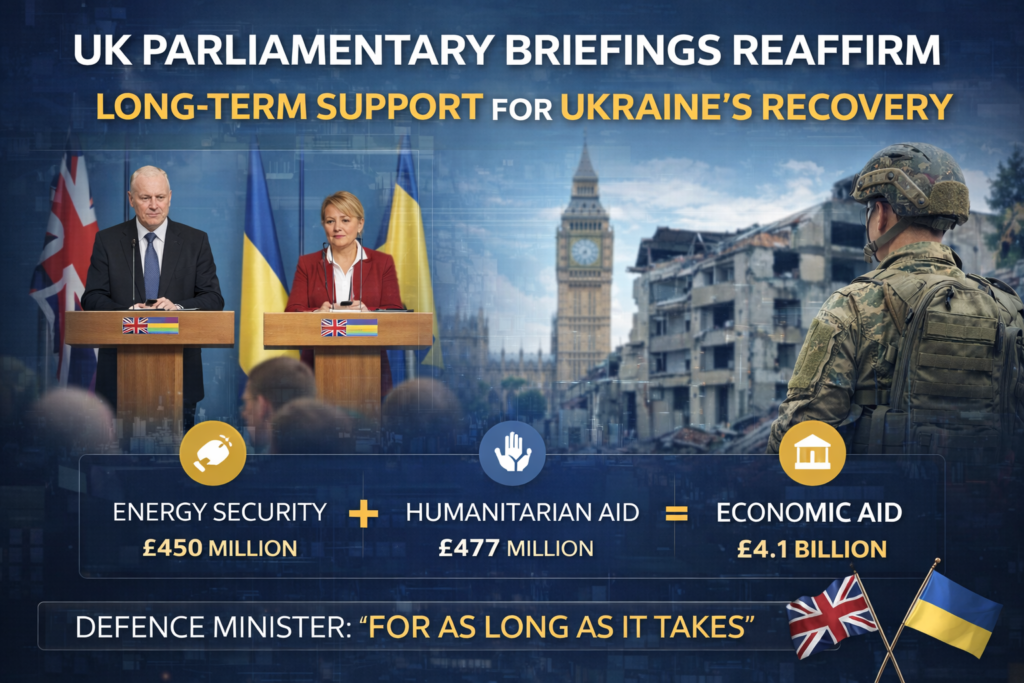
UK Parliamentary Briefings Reaffirm Long-Term Support for Ukraine’s Recovery

On October 27, 2025, the House of Lords Library published a comprehensive briefing “Ukraine Update: October 2025” ahead of debates held on October 31. The document confirms that the United Kingdom continues to frame support for Ukraine as a long-term strategic commitment extending far beyond immediate military aid to encompass humanitarian support, energy stabilization, and institutional recovery planning. In 2025, the UK and Germany assumed leadership of the Ukraine Defence Contact Group, while the UK and France are leading proposals for a “coalition of the willing” to support any potential peace agreement between Ukraine and Russia. During the October 31 debates, Defence Minister Lord Coaker and International Development Minister Baroness Chapman of Darlington presented the government’s position, emphasizing that “Ukraine’s security is inseparable from Euro-Atlantic security.” The briefing details British support across several key areas. For energy security, the UK has allocated over £450 million, including £133 million to the Ukraine Energy Support Fund for repairs, protection, and power generation. Humanitarian assistance totals £477 million from February 2022 to March 2025, with an additional £242 million in 2024/25 and up to £283 million for 2025/26. Total UK non-military support has reached £5 billion, including £4.1 billion in fiscal support through World Bank loan guarantees. Parliamentary communications highlighted the importance of governance reform, accountability mechanisms, and social resilience in shaping sustainable recovery outcomes. British policymakers stressed that recovery efforts must address displacement (5.2 million refugees globally, 3.8 million internally displaced), trauma, and institutional capacity alongside physical reconstruction. Key Facts: Expert Insight (SWRR Centre): The House of Lords briefing of October 27, 2025 and subsequent debates on October 31 demonstrate a critical evolutionary moment in British policy toward Ukraine – the transition from a focus on immediate military support to a comprehensive, multi-sector approach to long-term recovery. This aligns with our research showing that successful post-conflict recovery requires simultaneous investments in security, institutions, social resilience, and economic rebuilding. Particularly significant is the emphasis on ‘governance reform, accountability mechanisms and social resilience’ alongside physical reconstruction. Our research confirms: infrastructure without institutions, buildings without governance capacity, economic growth without social trust – all create fragile, unsustainable recovery. The British approach recognizes this, integrating the Good Governance Fund (£38m over 3 years) into the broader recovery strategy. The focus on energy security (£450+ million) also demonstrates understanding that energy is not merely infrastructure but the foundation for everything else: education (schools need heating), healthcare (hospitals need electricity), economy (businesses need stable supply). Russian attacks on Ukraine’s energy infrastructure recognize this nexus precisely. Integration of support for displaced persons (255,000 in UK) with broader recovery efforts creates a unique ‘circular recovery’ model: Ukrainians in the UK acquire skills, knowledge, connections that can be transported back for rebuilding. The school-twinning programme (54,000 students) is investment not in today but in the next generation of Ukrainian leadership. Critically, the UK positions this not as charity but as strategic imperative: ‘Ukraine’s security is our security.’ For research centers, this confirms our approach – post-conflict recovery is not merely a development or humanitarian question but a matter of international security and stability. Successful Ukrainian recovery has implications for all of Europe and the rules-based global order. Sources: House of Lords Library – “Ukraine Update: October 2025”, 27 October 2025 UK Parliament – House of Lords Hansard transcript, debate on Ukraine, 31 October 2025 House of Commons Library – “Ukraine: UK aid and humanitarian situation 2022 to 2025”, October 2025 House of Commons Library – “Military assistance to Ukraine: What has changed in 2025?”, 30 October 2025 Foreign, Commonwealth & Development Office – “UK support to Ukraine: Factsheet”, regularly updated UK Government – “Ukraine Donor Platform confirms support for Ukraine’s recovery and reconstruction”, 1 April 2025

UK Parliamentary Briefings Reaffirm Long-Term Support for Ukraine’s Recovery Read More »