
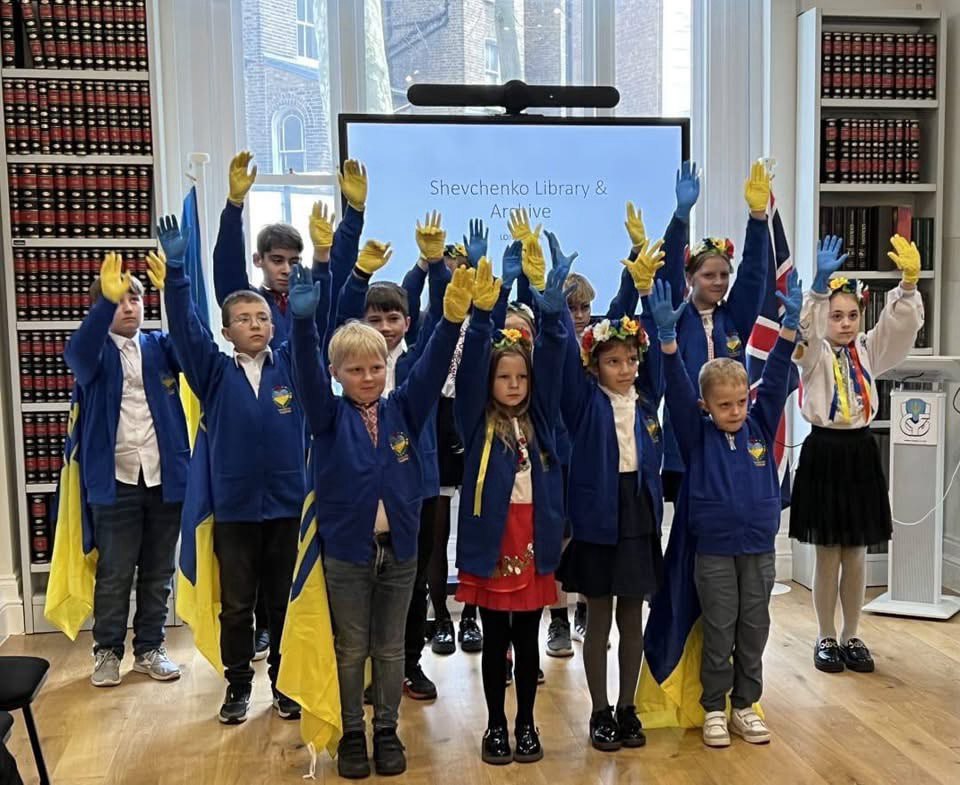
Ukrainian Schools in the United Kingdom: Centres of Education, Memory and Community
Ukrainian schools in the United Kingdom are far more than extra language classes.They have become spaces where communities are formed, cultural memory ispreserved, and a new generation of Ukrainians is supported as they grow upbetween two countries and two education systems. The story of these schoolsbegins immediately after the Second World War and continues especially vividlyafter 2022, when tens of thousands of new Ukrainian families arrived in Britain. Origins: Ukrainian Schools after the Second World WarAfter the Second World War, a significant number of Ukrainian displaced personssettled in the United Kingdom. In the late 1940s and early 1950s, the first UkrainianSaturday schools and preschool groups began to appear within the newly formedcommunities. They became the foundation for the development of Ukrainian-language education in the diaspora.The Association of Ukrainians in Great Britain (AUGB) played a major role in thisprocess. Ukrainian studies schools were opened at its branches in various cities −Bradford, Bolton, Manchester, Nottingham, London, Wolverhampton and others.Some of these schools existed for only a few years, while others worked fordecades, passing the language and culture on to the children and grandchildren ofpost-war emigrants.The coordination of Ukrainian supplementary education across the UK is supportedby the Association of Ukrainian Teachers in Great Britain (AUT), founded in 1955 asan autonomous organisation within the structure of the AUGB. The AUT’s missionencompasses three core functions: promoting the teaching of Ukrainian language,literature, history and geography among children of Ukrainian descent; settingcurricula and providing educational support to the network of community schoolsacross the country; and providing a forum for teachers to share experience andmaterials (Association of Ukrainian Teachers in Great Britain, 2025).The roots of organised Ukrainian teaching in the UK stretch back to 1955. By the late1960s the AUT had nearly 250 members, reaching a peak of almost 280 in the mid-1980s. However, by the 2017–2018 school year, only five Ukrainian supplementaryschools remained active across the entire country − in Bradford, Coventry, London,Manchester and Nottingham (Ukrainians in the UK Online, 2024). The events ofFebruary 2022 would transform this picture entirely.One of the best-known examples is St Mary’s Ukrainian School in London. It datesback to the 1950s, developed under the patronage of AUGB, and later became oneof the most important Ukrainian educational centres in the country. Thanks to suchschools, the Ukrainian language and traditions did not disappear by the second orthird generation in the diaspora but remained alive and active. After 2022: A New Wave, New SchoolsRussia’s full-scale invasion of Ukraine in February 2022 fundamentally transformedthe scale of the Ukrainian presence in the United Kingdom. By July 2024,approximately 210,000 individuals predominantly women and children − had arrivedin the country under British Government schemes specifically designed to facilitatethe movement of refugees from Ukraine.The arrival of this new wave had a profound impact not only on the numerical growthof the Ukrainian community but also on the entire infrastructure of Ukrainian civic lifein Britain. Existing institutions – including the Embassy and consulates of Ukraine,the Ukrainian Catholic Church (UCC) and the Ukrainian Autocephalous OrthodoxChurch (UAOC), the AUGB, the Association of Ukrainian Women, the UkrainianYouth Association, Plast Ukrainian Scouting Organisation, the Ukrainian InstituteLondon, the Association of Ukrainian Teachers, and aid organisations such asUkraine Charity and British-Ukrainian Aid − became heavily involved in fundraising,organising humanitarian aid deliveries to Ukraine, supporting newly arrived displacedpersons, and disseminating information about the situation in Ukraine.A leading coordinating role was played by the AUGB, often in close cooperation withthe British Government. Together with the Ukrainian Catholic Eparchy of the HolyFamily of London, the AUGB established the Ukrainian Welcome Centre, whichprovided newly arrived Ukrainians with practical assistance and information relatingto temporary residence in the UK. The Ukrainian Institute London significantlyexpanded its activities to meet the growing public demand for Ukrainian languagelearning and to enhance understanding of events in Ukraine.The arrival of displaced persons led to substantial growth in the congregations of theUCC and the UAOC, with new parishes formed in numerous locations. Membershipof the AUGB and other community organisations increased markedly, and newbranches were established in towns and cities that had previously had little or noUkrainian presence. The achievements of several prominent community memberswere recognised in the King’s 2023 and 2024 Birthday Honours Lists and the 2024New Year Honours List (Ukrainians in the UK Online, 2024).It is within this broader context of rapid institutional expansion that Ukrainiansupplementary schools experienced their most dramatic period of growth. ExistingSaturday and Sunday schools saw pupil numbers double and in some casesincrease several times over, while entirely new schools were established across thecountry — within communities, churches, parents’ initiatives, and charitableorganisations, including in online formats. The Current Network of Ukrainian Supplementary Schoolsin the UK: Scale, Geography and DiversityAn analysis of currently active Ukrainian supplementary schools in the UK reveals anationwide network of at least 33 schools operating across 29 towns and cities in 8regions of England and Scotland. The overwhelming majority − 27 schools, or 82 percent − operate on Saturdays, with five Sunday schools and one school meeting on weekday evenings. The geographic distribution reflects the broader settlementpatterns of displaced Ukrainians: London and the South East together account for 16schools, while significant clusters have also emerged in the West Midlands,Yorkshire, and Scotland. Collectively, these schools serve children aged between 2and 17 years, providing continuity of Ukrainian-language education across all stagesof childhood and early adolescence.The network has deep historical roots alongside remarkable recent growth. A core ofschools − in Bradford, Coventry, Manchester, Nottingham, and London − traces itsorigins to the post-war Ukrainian diaspora of the 1950s, having preserved theUkrainian language and culture across generations for over seven decades.However, the most dramatic transformation occurred after February 2022.The most striking illustration of post-2022 growth is the St Mary’s Ukrainian Schoolnetwork in London, which expanded from a single school with decades of history to anetwork of nine locations across Greater London and the South East.Simultaneously, entirely new schools emerged in cities with no prior Ukrainianeducational infrastructure − including Gloucester, Bristol, Exeter, Scarborough,Leicester and Leamington Spa − reflecting the geographic dispersal of newly arriveddisplaced Ukrainians across the United Kingdom.It should be noted that this list, compiled in April
Ukrainian Schools in the United Kingdom: Centres of Education, Memory and Community Read More »