
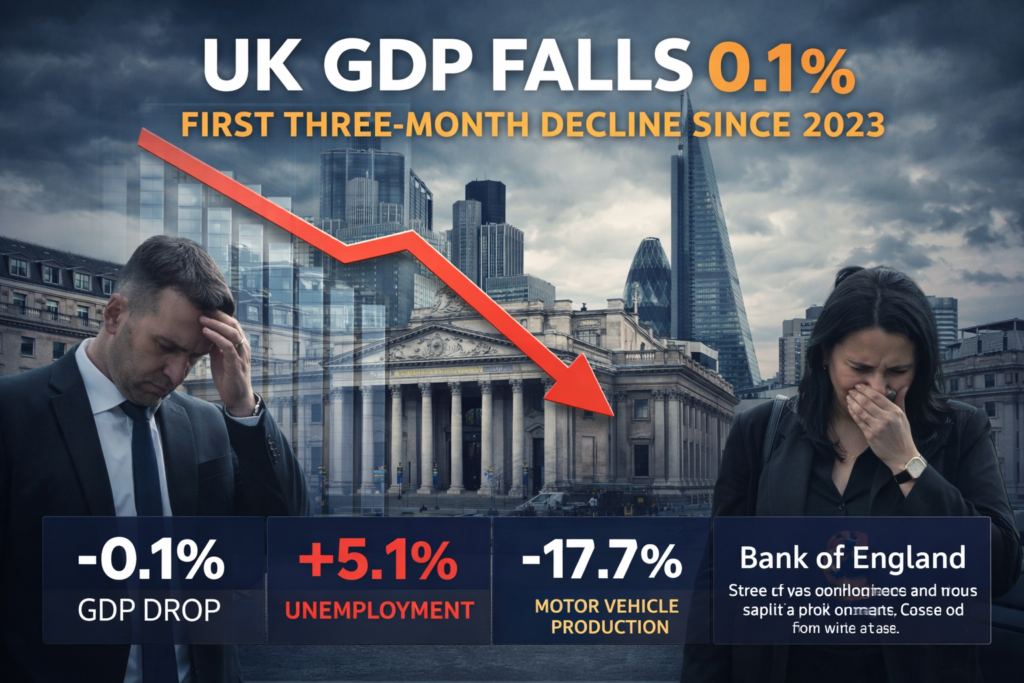
UK GDP Falls 0.1% in October – First Three-Month Decline Since 2023
The UK Office for National Statistics (ONS) published data today showing real GDP declined 0.1% in the three months to October 2025 compared to the three months to July. This marks the first three-month fall since December 2023, driven by significant contractions in manufacturing and construction amid rising unemployment.
The services sector showed no growth, while production fell 0.5% and construction dropped 0.3%. The largest contributor to the GDP decline was a 17.7% fall in motor vehicle manufacturing, partially attributed to a cyberattack on Jaguar Land Rover. Meanwhile, unemployment rose to 5.1% in the August-October 2025 period – the highest level since 2021.
Despite these headwinds, the UK banking system remains resilient. Bank of England stress tests confirmed that financial institutions are well-capitalized and capable of supporting the economy even under adverse conditions. However, the Financial Policy Committee reduced systemic capital buffer requirements from 14% to 13% of risk-weighted assets to support lending during the economic slowdown.
Key Facts:
- GDP: Declined 0.1% in August-October 2025 – first three-month fall in two years
- Sectoral breakdown: Services 0% growth, production –0.5%, construction –0.3%
- Automotive: Motor vehicle production fell 17.7%, partly due to JLR cyberattack
- Unemployment: Rose to 5.1% – highest level since 2021
- Banking sector: Stress tests confirmed resilience; capital requirements lowered from 14% to 13%
- Monetary policy: Bank of England continues gradual interest rate reduction strategy
Expert Insight (SWRR Centre):
A donor country’s economic resilience directly determines the scale and duration of its international recovery commitments. The Bank of England’s stress test results confirm that UK financial institutions can maintain support even under adverse conditions – this is critical for multi-year reconstruction projects such as support for Ukraine.
However, the concurrent rise in unemployment and GDP contraction creates tension between domestic needs and external commitments. The ‘financial stability as foundation’ principle underpins our research on how donor country economic health determines their capacity to provide sustained assistance.
A well-capitalized banking sector is not merely domestic infrastructure – it is the bedrock that enables Britain to function as a reliable partner in international reconstruction efforts, providing both direct financing and guarantees for development projects. Balancing fiscal consolidation with maintaining capacity for international aid will be a key challenge in 2026.
Sources:
Office for National Statistics (ONS) – GDP monthly estimate, UK: October 2025
Bank of England – Financial Stability Report, December 2025
Bank of England – Financial Policy Committee Record, October 2025
Reuters Economic Analysis, December 2025