
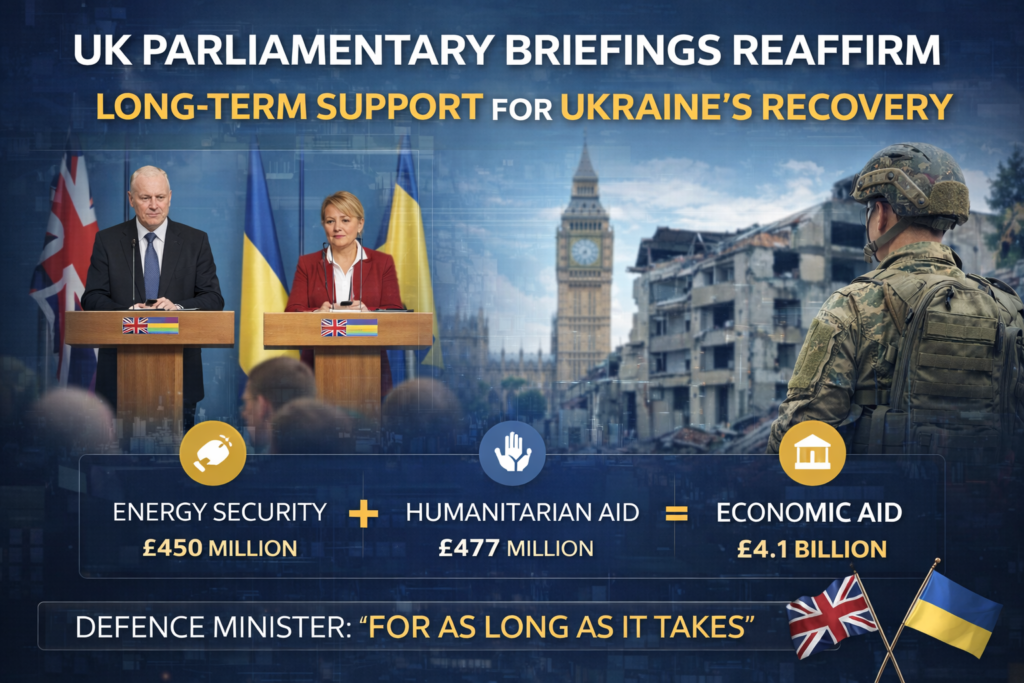
On October 27, 2025, the House of Lords Library published a comprehensive briefing “Ukraine Update: October 2025” ahead of debates held on October 31. The document confirms that the United Kingdom continues to frame support for Ukraine as a long-term strategic commitment extending far beyond immediate military aid to encompass humanitarian support, energy stabilization, and institutional recovery planning.
In 2025, the UK and Germany assumed leadership of the Ukraine Defence Contact Group, while the UK and France are leading proposals for a “coalition of the willing” to support any potential peace agreement between Ukraine and Russia. During the October 31 debates, Defence Minister Lord Coaker and International Development Minister Baroness Chapman of Darlington presented the government’s position, emphasizing that “Ukraine’s security is inseparable from Euro-Atlantic security.”
The briefing details British support across several key areas. For energy security, the UK has allocated over £450 million, including £133 million to the Ukraine Energy Support Fund for repairs, protection, and power generation. Humanitarian assistance totals £477 million from February 2022 to March 2025, with an additional £242 million in 2024/25 and up to £283 million for 2025/26. Total UK non-military support has reached £5 billion, including £4.1 billion in fiscal support through World Bank loan guarantees.
Parliamentary communications highlighted the importance of governance reform, accountability mechanisms, and social resilience in shaping sustainable recovery outcomes. British policymakers stressed that recovery efforts must address displacement (5.2 million refugees globally, 3.8 million internally displaced), trauma, and institutional capacity alongside physical reconstruction.
Key Facts:
- Debates: House of Lords debated Ukraine on 31 October 2025 with Defence and International Development Ministers
- Leadership: UK and Germany lead Ukraine Defence Contact Group in 2025; UK and France lead “coalition of the willing” initiative
- Energy: Over £450m for energy security, including £133m to Energy Support Fund
- Humanitarian aid: £477m (Feb 2022-March 2025); £242m (2024/25); up to £283m (2025/26)
- Fiscal support: £4.1bn via World Bank loan guarantees for economic stability
- Military support: £3bn annually through 2030/31 and “for as long as it takes”; £10bn total since Feb 2022
- Displacement: 5.2m refugees globally, 3.8m IDPs; ~255,000 Ukrainian refugees in UK
- Recovery costs: World Bank estimates reconstruction at $524m (as of April 2025)
- 100 Year Partnership: UK marked first anniversary of historic partnership with Ukraine, including school-twinning programme (54,000 British and Ukrainian students)
Expert Insight (SWRR Centre):
The House of Lords briefing of October 27, 2025 and subsequent debates on October 31 demonstrate a critical evolutionary moment in British policy toward Ukraine – the transition from a focus on immediate military support to a comprehensive, multi-sector approach to long-term recovery. This aligns with our research showing that successful post-conflict recovery requires simultaneous investments in security, institutions, social resilience, and economic rebuilding.
Particularly significant is the emphasis on ‘governance reform, accountability mechanisms and social resilience’ alongside physical reconstruction. Our research confirms: infrastructure without institutions, buildings without governance capacity, economic growth without social trust – all create fragile, unsustainable recovery. The British approach recognizes this, integrating the Good Governance Fund (£38m over 3 years) into the broader recovery strategy.
The focus on energy security (£450+ million) also demonstrates understanding that energy is not merely infrastructure but the foundation for everything else: education (schools need heating), healthcare (hospitals need electricity), economy (businesses need stable supply). Russian attacks on Ukraine’s energy infrastructure recognize this nexus precisely.
Integration of support for displaced persons (255,000 in UK) with broader recovery efforts creates a unique ‘circular recovery’ model: Ukrainians in the UK acquire skills, knowledge, connections that can be transported back for rebuilding. The school-twinning programme (54,000 students) is investment not in today but in the next generation of Ukrainian leadership.
Critically, the UK positions this not as charity but as strategic imperative: ‘Ukraine’s security is our security.’ For research centers, this confirms our approach – post-conflict recovery is not merely a development or humanitarian question but a matter of international security and stability. Successful Ukrainian recovery has implications for all of Europe and the rules-based global order.
Sources:
House of Lords Library – “Ukraine Update: October 2025”, 27 October 2025
UK Parliament – House of Lords Hansard transcript, debate on Ukraine, 31 October 2025
House of Commons Library – “Ukraine: UK aid and humanitarian situation 2022 to 2025”, October 2025
House of Commons Library – “Military assistance to Ukraine: What has changed in 2025?”, 30 October 2025
Foreign, Commonwealth & Development Office – “UK support to Ukraine: Factsheet”, regularly updated
UK Government – “Ukraine Donor Platform confirms support for Ukraine’s recovery and reconstruction”, 1 April 2025