
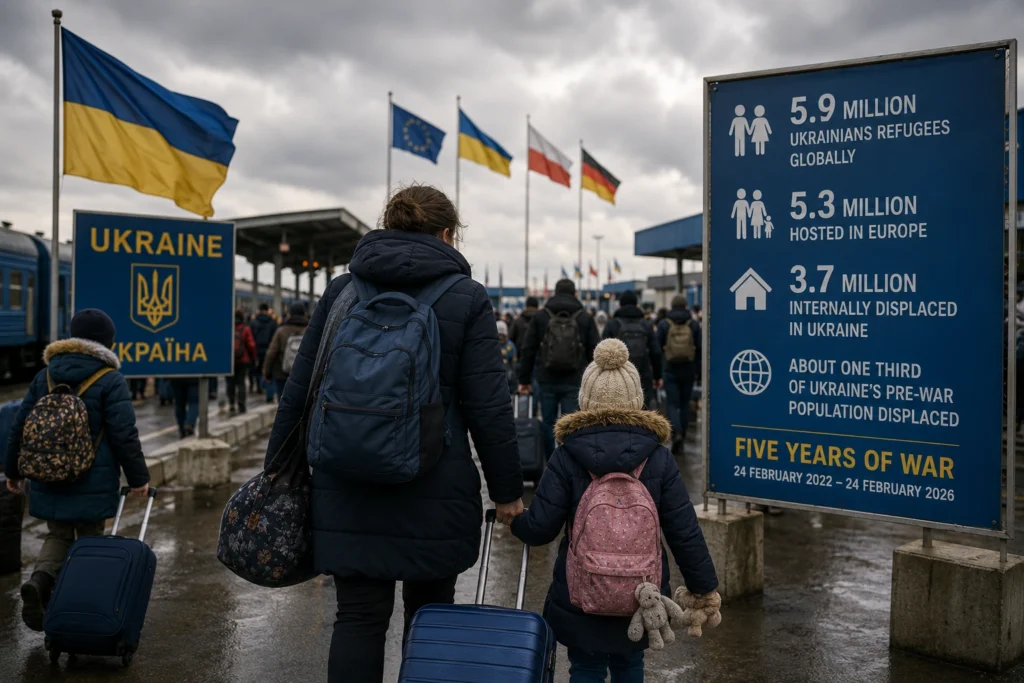
On February 24, 2026, Ukraine entered the fifth year of Russia’s full-scale invasion — a milestone
that arrived with no end in sight and a displacement crisis that has reshaped the demographics of an
entire country. As of February 2026, 5.9 million Ukrainians had been recorded as refugees globally,
with 5.3 million of them hosted across Europe. A further 3.7 million remained internally displaced
within Ukraine, with 79% having been displaced for more than a year and 40% having experienced
multiple displacements. Together, these figures mean that approximately one third of Ukraine’s pre-
war population of 41 million has been forcibly displaced — internally or externally — at some
point since February 2022.
The displacement crisis has a pronounced demographic structure. Women and children constitute
approximately 76% of external refugees, a direct consequence of Ukrainian martial law prohibiting
men aged 18 to 60 from leaving the country. At the end of April 2026, Eurostat data showed that
adult women accounted for 43.4% of those under EU temporary protection, minors for 29.9%, and
adult men for just 26.7% — and the male share has been declining quarter-on-quarter, dropping 6
percentage points between Q4 2025 and Q1 2026 as new arrivals skew increasingly female and
young. The largest EU hosts remain Germany (approximately 1.2–1.33 million), Poland
(approximately 1 million), and Czechia — which, relative to its population size, hosts the highest
concentration in the EU at 35.2 beneficiaries per 1,000 people. The United Kingdom, outside the
EU’s Temporary Protection Directive framework, hosts approximately 264,000–285,000 Ukrainians
under the Homes for Ukraine and Ukraine Family schemes.
The EU’s Temporary Protection Directive, extended unanimously by the Council until March 4,
2027, provides beneficiaries with residence rights, labour market access, healthcare, and education.
At end-April 2026, 4.4 million people were under this status across the EU — a figure that has
continued to edge upward, rising by approximately 43,000 in April alone. However, the political
environment around temporary protection is shifting. In June 2026, European Commission
President Ursula von der Leyen signalled consideration of altering the Directive’s terms in response
to Ukraine’s mobilisation crisis, with EU member states debating whether new male arrivals aged
23–60 subject to Ukrainian mobilisation law should be excluded from temporary protection — a
question that sits at the intersection of refugee law, military necessity, and the sovereignty of
member states to manage their own labour markets and defence obligations.
Return dynamics remain complex and contested. By September 2025, an estimated 1.4 million
refugees from Ukraine had returned to their country of origin and remained there for at least three
months — but 325,000 of those returnees were at risk of secondary displacement by February 2026
due to continued energy infrastructure attacks and winter conditions. UNHCR’s intentions surveys
show 57% of refugees expressing interest in returning home one day, with access to safety, housing,
social services, and employment as the critical conditions. The proportion wanting to return has,
however, been falling — from 83% in 2022 to 61% in 2024 — as integration in host countries
deepens and uncertainty about Ukraine’s post-war future persists.
Key Facts:
Global refugees: 5.9 million Ukrainians recorded globally as of February 2026 (UNHCR);
5.3 million in Europe
Internally displaced: 3.7 million within Ukraine (as of December 2025/February 2026); 79%
displaced for over a year; 40% displaced multiple times
EU temporary protection: 4.4 million beneficiaries at end-April 2026; extended to March 4,
2027 (Council decision, June 2025)
Demographic structure (EU, April 2026): adult women 43.4%; minors 29.9%; adult men
26.7% — male share declining q/q
Largest EU hosts (approximate): Germany 1.2–1.33 million; Poland ~1 million; Czechia
~510,000; highest per-capita concentration: Czechia (35.2 per 1,000), Poland (26.6),
Slovakia (26.5)
UK: ~264,000–285,000 Ukrainians under Homes for Ukraine and Ukraine Family schemes
— fourth highest globally; outside EU TPD framework
Returnees: ~4.41 million have returned to places of residence since 2022 (IOM); ~1.4
million returned and remained in Ukraine for 3+ months by September 2025; 325,000 at risk
of secondary displacement (IOM, February 2026)
Return intentions: 57% of refugees interested in returning (UNHCR); down from 83%
(2022) and 61% (2024)
Military-age men: 650,000+ military-age Ukrainian men registered as refugees across EU,
Norway, Switzerland, Liechtenstein; June 2026 — EC president signals possible exclusion
of new male arrivals aged 23–60 from temporary protection
Humanitarian needs inside Ukraine: 10.8 million people requiring assistance in 2026
(HNRP); 2.5 million families lacking adequate shelter; 13% of housing stock (2.5 million
homes) damaged or destroyed
UNHCR 2026 target: reach 2.1 million people in Ukraine and neighbouring countries
Fifth-year milestone: February 24, 2026 — deadliest year for civilians since 2022; 2,514
killed and 12,142 injured in 2025, a 31% rise on 2024
Expert Insight (SWRR Centre):
Five years into the full-scale invasion, the Ukrainian displacement crisis is no longer an emergency
in the conventional sense — it is a structural condition with long-term implications for both Ukraine
and its European host countries. The numbers have stabilised rather than continued to grow
exponentially, but stability at this scale represents a permanent reconfiguration: 5.3 million
Ukrainians embedded across European labour markets, education systems, housing stock, and social
services, with return timelines that grow more uncertain with each passing year.
The demographic structure of the displacement is increasingly significant. The combination of
Ukrainian martial law restricting male emigration and the accumulation of women and children in
European host countries has produced a refugee population that is disproportionately female, young,
and educationally active. UNHCR’s May 2026 Socio-Economic Insights Survey found that 57% of
Ukrainian refugees in Europe are employed — a higher labour market participation rate than many
previous refugee crises — but they remain 22 percentage points behind host-country nationals in
earnings and labour market outcomes. That gap is narrowing, but slowly, and the longer
displacement continues, the more it reflects structural integration rather than temporary disruption.
The most politically charged dimension of the crisis in mid-2026 is the question of military-age
men. The European Commission’s signalling toward possible exclusion of new male arrivals from
temporary protection is a response to Ukrainian and Polish pressure, but it raises fundamental
questions about the interaction between refugee protection law and the conscription obligations of a
sovereign state at war. There is no precedent in the Temporary Protection Directive for conditioning
protection on a beneficiary’s military eligibility in their country of origin; if pursued, it would
represent a significant departure from the humanitarian logic on which the Directive was founded.
Whether it advances into policy — and how the European Court of Justice would interpret it — will
be one of the most consequential legal developments in European refugee law in years.
Sources:
UNHCR / USA for UNHCR — “Ukraine Refugee Crisis: Aid, Statistics and News,” updated June
2026
UNHCR — “Ukraine Situation: 2026 Plans and Financial Requirements”
Eurostat — “Temporary protection for persons fleeing Ukraine — monthly statistics,” end-April
2026
IOM — “325,000 Ukrainian Returnees Risk Displacement Again,” February 16, 2026
IOM — Ukraine Crisis Response Plan 2026
Wikipedia — “Ukrainian refugee crisis,” updated June 2026
USCRI — “Country Conditions: Ukraine February 2026”