
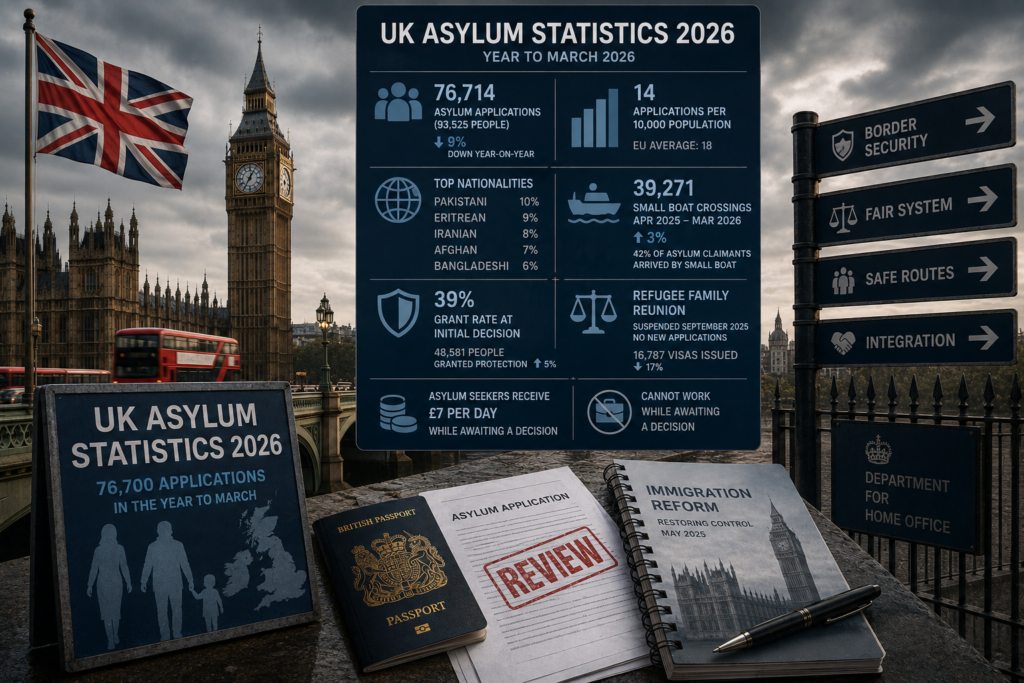
There were 76,714 asylum applications in the UK in the year to March 2026, relating to 93,525 people — a 9% decrease from the previous twelve months and the second consecutive annual fall after the record of 105,000 applications in 2024. On a per-capita basis, the UK received approximately 14 asylum applications for every 10,000 people — below the EU member state average of 18 per 10,000, placing the UK 12th on a combined list of the 27 EU member states and the UK. The figures do not include Ukrainians, who are covered by separate humanitarian schemes and do not enter the general asylum statistics.
The most common nationalities applying for asylum in the year to March 2026 were Pakistani (10%), Eritrean (9%), Iranian (8%), Afghan (7%), and Bangladeshi (6%) — together accounting for 40% of all applicants. Around 42% of those who claimed asylum in that year arrived by small boat
across the Channel, up from roughly a third since 2018. Channel crossings totalled 39,271 between April 2025 and March 2026, a 3% increase on the previous year, though the trend has since reversed: as of late May 2026, crossings were running 40% lower than at the same point in 2025.
The UK and France agreed a new three-year funding arrangement in April 2026, worth £662 million, to address unauthorised migration including small boat crossings.
At initial decision stage, 39% of decisions in the year to March 2026 resulted in a grant of protection — meaning those people were confirmed as refugees or received humanitarian protection. A total of 48,581 people were granted protection as a result of an asylum claim, a 5% increase from the previous year. The proportion of asylum appeals allowed in 2025 was 39%, broadly unchanged from the prior year, though an increasing number of appeals are being withdrawn before courts make a decision. On positive asylum decisions per capita, the UK granted approximately four per 10,000 people in 2025 — below the EU average of seven, with Greece granting the most (26 per 10,000) and Hungary the fewest.
Refugee family reunion — one of the main safe and legal routes to the UK for refugees joining family members — has been suspended since September 2025. The government announced it was closing the route to new applications while reviewing its conditions, citing concerns that it was
encouraging asylum claims and adding pressure on housing and public services. In the year to March 2026, 16,787 family reunion visas were issued — a 17% fall reflecting the closure — with nine in ten granted to women and children. From 2010 to March 2026, a total of 115,500 visas were granted through this route in total. The route was due to reopen but no firm date has been confirmed.
The broader asylum framework is undergoing significant reform under the Labour government’s immigration white paper, Restoring Control over the Immigration System (May 2025), and the subsequent policy statement Restoring Order and Control (November 2025). Changes already in force include: reducing refugee immigration permission to 30 months at a time (down from an indefinite grant); a “visa brake” banning nationals of Afghanistan, Cameroon, Myanmar, and Sudan from certain mainstream visa routes (in force from March 2026); and new rules on asylum support taking effect from March 26, 2026. New capped immigration routes for refugee and displaced students and skilled workers are due to open in autumn 2026.
Key Facts:
Asylum applications: 76,714 (93,525 people) in the year to March 2026 — down 9% year-on-year; record was 105,000 in 2024
Per-capita rate: 14 applications per 10,000 UK population; EU average 18 per 10,000; UK ranked 12th on combined EU27 and UK list
Ukrainian asylum seekers: not included in general asylum statistics — covered by separate Homes for Ukraine and Ukraine Permission Extension schemes
Top nationalities (year to March 2026): Pakistani 10%, Eritrean 9%, Iranian 8%, Afghan 7%, Bangladeshi 6% — together 40% of all applicants
Small boats: 39,271 crossings April 2025 to March 2026 (+3% y/y); 42% of asylum claimants in that year arrived by small boat; crossings down 40% year-on-year as of late May 2026
UK-France agreement: new three-year funding cycle agreed April 2026, worth £662 million, to tackle unauthorised migration
Grant rate (initial decision, year to March 2026): 39% — 48,581 people granted protection, up 5% year-on-year
Positive decisions per capita (2025): UK 4 per 10,000; EU average 7; Greece highest (26); Hungary lowest (0.04)
Appeal outcomes (2025): 39% of determined appeals allowed; increasing number withdrawn before decision
Immigration detention: 22,586 people detained in year to March 2026, including 13,354 asylum seekers (up 10% year-on-year)
Refugee Family Reunion: suspended September 2025 — no new applications; 16,787 visas issued in year to March 2026 (down 17%); total 115,500 visas from 2010 to March 2026; nine in ten granted to women and children
Key reforms in force (2026): refugee status reduced to 30-month grants; “visa brake” on Afghan, Cameroonian, Myanmar, Sudanese nationals (March 2026); new asylum support rules (March 26, 2026)
Planned (autumn 2026): new capped routes for refugee and displaced students and skilled workers Asylum seekers receive £7 per day from the government while awaiting a decision and cannot work
Expert Insight (SWRR Centre):
The 9% fall in asylum applications and the below-EU-average per-capita rate are figures that appear in public debate with very different interpretations depending on the political starting point. Those arguing the UK asylum system is under unsustainable pressure tend not to lead with these numbers; those arguing the UK takes a proportionally modest share of European asylum seekers relative to its size and wealth do. Both readings are technically supportable from the same dataset, which is itself a useful illustration of how asylum statistics function as political instruments as much as administrative ones.
The suspension of the Refugee Family Reunion route is the single most consequential recent policy change in terms of its humanitarian impact. Family reunion is widely considered by refugee specialists to be one of the safest and most effective legal routes — it reunites people with existing family ties in the UK, reducing irregular arrival incentives and providing a ready-made support network for integration. Suspending it on the basis that it may be encouraging asylum claims represents a significant reversal of the logic underlying safe and legal routes policy, and the government has not provided detailed evidence for the causal claim. Nine in ten family reunion visas go to women and children — the suspension’s demographic impact is therefore highly gendered.
The shift to 30-month temporary refugee status — replacing what had previously been an indefinite grant for recognised refugees — is a structural change whose long-term effects will take years to become visible. It introduces a recurring review burden for both the Home Office and refugees
themselves, and raises questions about integration incentives: research consistently shows that security of status is one of the strongest predictors of successful labour market integration and civic participation among refugees. Whether the policy achieves its stated aim of increasing returns when conditions in countries of origin improve — or whether it primarily generates administrative churn without materially changing outcomes — will be testable by the time the first 30-month grants come up for renewal.
Sources:
House of Commons Library — “Asylum statistics,” Research Briefing SN01403, updated May 29, 2026
Refugee Council — “Top facts from the latest statistics on refugees and people seeking asylum,” year ending March 2026
House of Commons Library — “Immigration reforms,” updated June 2026
House of Commons Library — “Special visa schemes for Ukrainians,” CBP-9473, updated April 2026
Home Office — “Immigration Statistics, year ending March 2026,” published May 2026