
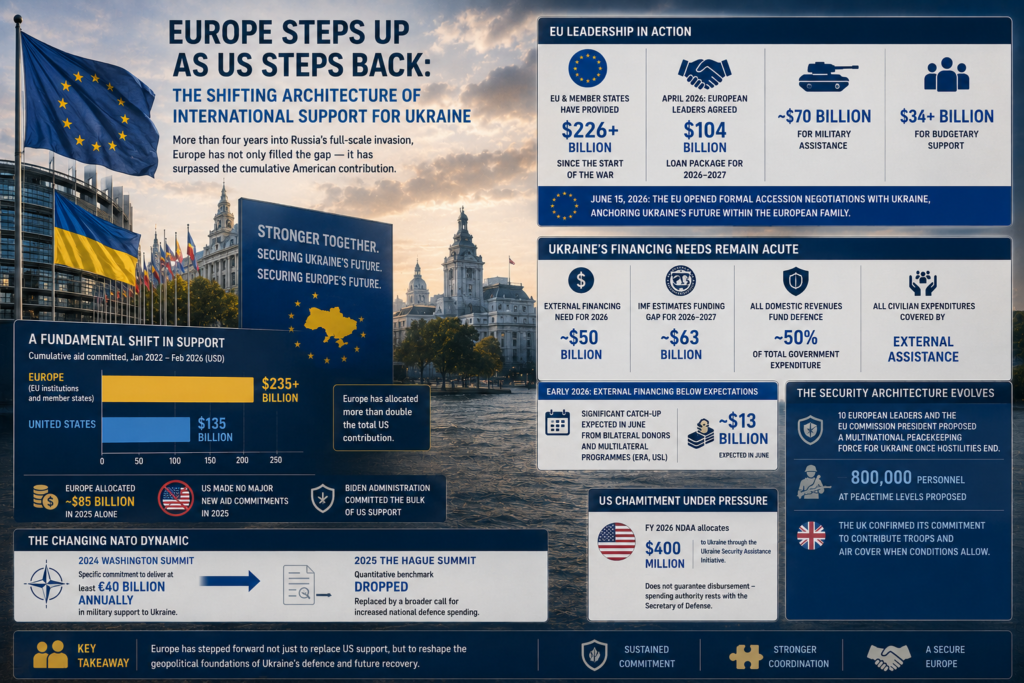
More than four years into Russia’s full-scale invasion of Ukraine, the architecture of international support has undergone a structural transformation. The United States, which led Western assistance in the early years of the war, has effectively paused new financial and military commitments since early 2025. Europe has not only filled the gap — it has surpassed the cumulative American contribution, reshaping the geopolitical foundations on which Ukraine’s defence and eventual recovery depend.
The scale of the shift is significant. Between January 2022 and February 2026, European countries collectively allocated more than 235 billion dollars in military, financial, and humanitarian aid to Ukraine — more than double the total US contribution of approximately 135 billion dollars over the same period. The United States committed the bulk of its support under the Biden administration, with no major new funding approved since 2024. In contrast, European countries allocated around 85 billion dollars in 2025 alone, accelerating their contributions precisely as Washington drew back.
The European Union has emerged as the single largest institutional backer. Since the start of the war, the EU and its member states have made available over 226 billion dollars in combined assistance. In April 2026, European leaders agreed a further loan package of 104 billion dollars to cover Ukraine’s needs through 2026 and 2027 — of which nearly 70 billion is earmarked for military assistance and over 34 billion for budgetary support. In a significant parallel development, the EU opened formal accession negotiations with Ukraine on 15 June 2026, anchoring the country’s long-term future within the European institutional order.
Ukraine’s financing needs remain acute. The IMF estimates a funding gap of approximately 63 billion dollars for 2026–2027, with total external financing requirements for 2026 placed at around 50 billion dollars. All domestic budget revenues are directed to defence, which accounts for roughly half of total government expenditure; civilian spending is covered entirely by external assistance.
Early 2026 saw external financing arrive below expected levels, though a significant catch-up was anticipated in June from bilateral donors and multilateral programmes including the ERA and USL facilities.
The shift in burden has exposed structural tensions within the Western coalition. The 2024 NATO summit in Washington included a specific collective commitment to deliver at least 40 billion euros annually in military support to Ukraine. By the 2025 Hague summit, that benchmark had been dropped, replaced by a broader call for increased national defence spending. The US NDAA for fiscal year 2026 allocated 400 million dollars to Ukraine through the Ukraine Security Assistance Initiative — a modest figure compared to earlier years, and one that does not guarantee disbursement, as spending authority ultimately rests with the Secretary of Defense.
Europe’s response has included not only financial commitments but steps toward a new security architecture. Ten European leaders, alongside the European Commission President, proposed a multinational peacekeeping force for Ukraine to be deployed once hostilities end, backed by a sustained force of 800,000 personnel at peacetime levels. The UK confirmed its commitment to contributing troops and air cover to such a mission when conditions allow.
Key Facts:
- Europe has now allocated more than 235 billion dollars to Ukraine since 2022 — more than double the US total of approximately 135 billion dollars
- The US made no major new aid commitments in 2025; European countries allocated approximately 85 billion dollars in 2025 alone
- In April 2026, European leaders agreed a further 104 billion dollar loan package for 2026–2027
- The EU opened formal accession negotiations with Ukraine on 15 June 2026
- Ukraine’s estimated external financing need for 2026 stands at approximately 50 billion dollars
- The IMF estimates a 63 billion dollar funding gap for Ukraine for 2026–2027
- The 2025 NATO Hague summit dropped the specific quantitative aid benchmark included in the 2024 Washington declaration
Expert Insight (SWRR Centre)
The reconfiguration of international support for Ukraine is analytically significant beyond the immediate military and fiscal dimensions. It represents a live stress test of what Western institutional solidarity looks like when the principal guarantor of that solidarity changes its strategic priorities.
Several questions arise from this shift that are directly relevant to understanding governance and institutional resilience under crisis conditions. The first concerns sustainability. European support has grown impressively in aggregate, but it remains fragmented across bilateral commitments, EU
instruments, and NATO frameworks — each with different decision-making cycles, disbursement mechanisms, and political accountability structures. The Kiel Institute and CSIS assessments both note that the challenge for Europe is less aggregate spending capacity than the structural ability to deliver specific capabilities — particularly air defence systems and large-calibre artillery — at the scale and consistency Ukraine requires.
The second concerns the political durability of support over time. The withdrawal of a clear quantitative benchmark at the 2025 NATO summit is a meaningful signal: it reflects the difficulty of maintaining binding collective commitments across democratically elected governments facing
domestic fiscal pressures. For researchers studying how institutions perform under sustained crisis conditions, the Ukraine support architecture offers an unusually well-documented case of coalition management at scale — its partial successes, coordination failures, and adaptation under pressure all visible in real time.
The opening of EU accession negotiations in June 2026 adds a further dimension: it transforms the relationship between Ukraine and its primary backers from emergency support to institutional integration, with different incentive structures and accountability mechanisms. Whether that
transition strengthens or complicates the continuity of support during active conflict is a question without clear precedent.
Sources
European External Action Service, EU Assistance to Ukraine, updated June 16, 2026:
https://www.eeas.europa.eu/delegations/united-states-america/eu-assistance-ukraine-us-dollars_en
Council on Foreign Relations, How Much Aid Has the US Sent Ukraine, updated June 26, 2026:
https://www.cfr.org/articles/how-much-us-aid-going-ukraine
CEPA, Wartime Assistance to Ukraine: Successes, Failures and Future Prospects, January 2026:
https://cepa.org/comprehensive-reports/wartime-assistance-to-ukraine-the-successes-failures-and-
future-prospects-of-us-and-eu-support-models/
OSW Centre for Eastern Studies, US Defence Budget for 2026, December 2025:
https://www.osw.waw.pl/en/publikacje/analyses/2025-12-19/us-defence-budget-2026-congress-
approves-continued-support-ukraine
CSIS, How Europe Can Build Ukraine’s Future Force, May 2026:
https://www.csis.org/analysis/how-europe-can-build-ukraines-future-force