
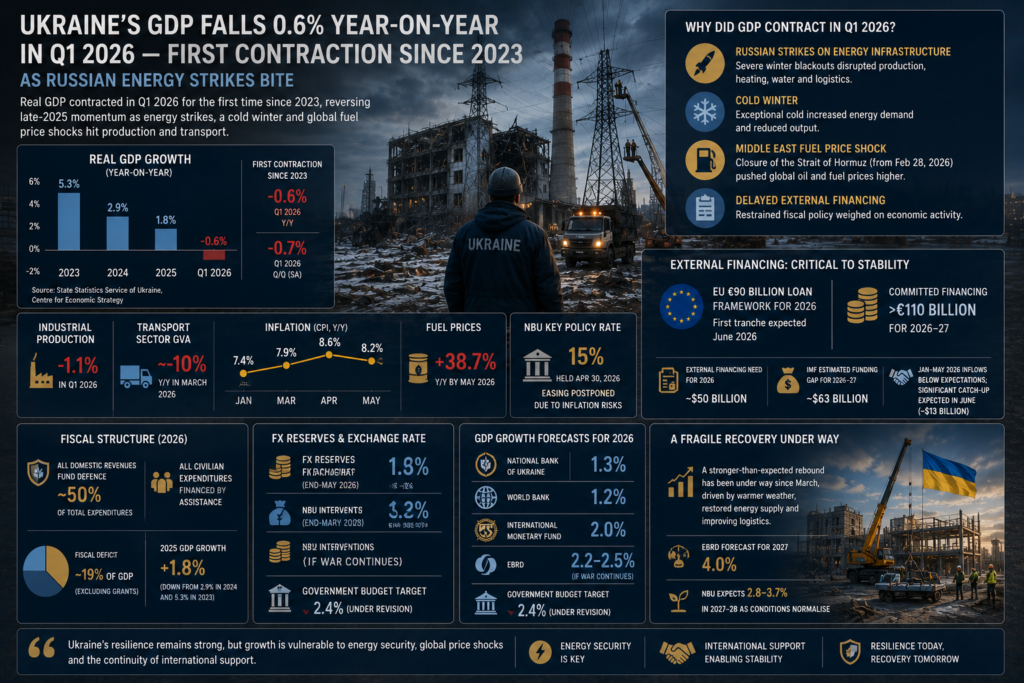
Ukraine’s real GDP contracted in the first quarter of 2026 for the first time since 2023, declining between 0.5% and 0.6% year-on-year and 0.7% quarter-on-quarter on a seasonally adjusted basis, according to Ukraine’s State Statistics Service and the Centre for Economic Strategy. The
contraction marks a sharp reversal from the momentum of late 2025, when quarterly growth had accelerated to 2.1% in Q3 and 3.0% in Q4 year-on-year.
The primary cause was a severe energy crisis triggered by intensified Russian strikes on Ukraine’s energy infrastructure during an exceptionally cold winter. Long blackouts disrupted industrial production, water and heating supplies, and logistics across the country. Industrial output fell 1.1%
in Q1, with the sharpest declines in January and February before a partial rebound in March as temperatures rose and some energy supply was restored. The transport sector was among the hardest hit, with gross value added falling approximately 10% year-on-year in March alone, driven
by higher fuel costs and reduced volumes of iron ore and oil shipping. Restrained fiscal policy — linked to delays in external financing — also weighed on activity.
A second external shock compounded the domestic energy crisis: the closure of the Strait of Hormuz from February 28, 2026 following the Israel-US strikes on Iran pushed global oil and fuel prices higher, feeding directly into Ukraine’s import-dependent fuel costs and business energy bills.
Fuel prices rose 38.7% year-on-year by May 2026, becoming a significant driver of renewed inflation. After easing to 7.4% year-on-year in January 2026, inflation climbed to 7.9% in March, 8.6% in April, and eased only slightly to 8.2% in May.
Ukraine’s Economy Minister Oleksii Sobolev confirmed in May that the government is preparing a downward revision of its macroeconomic forecast, reducing the 2.4% growth target set in the state budget. The National Bank of Ukraine also cut its 2026 growth forecast to 1.3% from 1.8%, citing
the weak Q1 result, the fragile state of the energy system, and Middle East war spillovers. However, the government noted that a stronger-than-expected rebound has been under way since March, and expressed hope that spring recovery momentum would partially offset the Q1 losses.
Key Facts:
- Q1 2026 GDP: -0.5% to -0.6% year-on-year; -0.7% quarter-on-quarter (seasonally adjusted) — first contraction since 2023
- 2025 full-year GDP growth: +1.8% (down from 2.9% in 2024 and 5.3% in 2023); economy still approximately 20% smaller than pre-invasion levels
- Main drivers of Q1 contraction: Russian strikes on energy infrastructure, cold winter blackouts, delayed external financing, Middle East fuel price shock
- Industrial production: -1.1% in Q1 2026; transport sector GVA -~10% y/y in March
- Inflation: 7.4% (Jan) → 7.9% (Mar) → 8.6% (Apr) → 8.2% (May 2026); fuel prices +38.7% y/y
- NBU key policy rate: held at 15% (April 30, 2026) — easing postponed due to rising inflation risks
- FX reserves: $45.7bn (end of May 2026), down 5.2% on the month; NBU intervening at $3.2bn/month to support hryvnia
- External financing: EU €90bn loan framework for 2026; first tranche expected June 2026; committed financing >€110bn for 2026–27
- GDP forecasts for 2026: NBU 1.3%; World Bank 1.2%; IMF 2.0%; EBRD 2.2–2.5% (assuming war continues); government budget target was 2.4% (under revision)
- EBRD forecast for 2027: 4.0%; NBU expects 2.8–3.7% in 2027–28 as conditions normalise.
Expert Insight (SWRR Centre):
Ukraine’s Q1 2026 contraction is a textbook illustration of how compound shocks interact in a war economy. The energy crisis was not new — Russian strikes on energy infrastructure have been a persistent feature of the war — but the combination of an unusually cold winter, intensified bombardment, and an external fuel price shock from the Middle East created a confluence that proved sufficient to reverse the growth trajectory of late 2025. The speed of the reversal — from 3.0% growth in Q4 2025 to a contraction in Q1 2026 — reflects the structural fragility of an economy that, despite considerable resilience, remains dependent on weather, external financing cycles, and global energy prices simultaneously.
The divergence between international forecasters is itself instructive. The gap between the World Bank’s 1.2% and the EBRD’s 2.5% for the same year reflects genuine uncertainty about how quickly the energy system can recover and how much of the Q1 contraction is genuinely seasonal versus structural. The Economy Minister’s note of a “strong rebound since March” suggests the lower forecasts may prove too pessimistic — but the same officials are simultaneously revising the budget target downward, which captures the difficulty of forecasting in a live conflict environment.
The degree to which external financing is holding the macro framework together is also worth noting. Ukraine’s fiscal deficit is fully financed by external partners; without that, the monetary and exchange rate stability the NBU has maintained would not be possible. This makes Ukraine’s
economic trajectory unusually sensitive to the political decisions of donor governments — a dynamic that extends beyond economics into governance and security policy.
Sources:
Centre for Economic Strategy — “Ukraine War Economy Tracker,” updated June 11, 2026
Reuters / Global Banking & Finance — “Ukraine’s GDP Shrinks 0.5% in Q1 2026,” May 5, 2026
Kyiv Post — “Ukraine’s GDP Shrinks 0.5% in Q1 2026 as War Strain Persists,” May 8, 2026
New Voice of Ukraine — “Ukraine government cuts GDP growth forecast after energy strikes caused Q1 contraction,” May 18, 2026
EBRD — “Ukraine maintains macroeconomic stability despite war,” Regional Economic Prospects, February 26, 2026
Interfax Ukraine — “Ukraine’s real GDP contracting for third consecutive month, declines 0.6% in Q1 2026,” April 22, 2026